Let me start by laying the foundations of my context through the names I have taken. I was born Andrew Denis Egan.
Andrew; after the patron saint of Scotland, a nod to my mothers heritage, born in Peebles, a small town somewhere between Glasgow, Edinburgh and the border.
Denis; after my grandfather, from Dublin, who had passed a year prior to my birth and to whose passing I owe my existence.
And Egan; a common Irish surname, taken from my Dad and originating somewhere on the West coast (though my family are from Dublin and Mullingar).
My parents ultimately settled on calling me Drew.
Drew; shortened form of Andrew, with a softer connotation, more playful.
To quote my mother on the decision: “I wanted Drew, but your Dad said Andrew Denis Egan sounded better”. This conflict moved back and forth during my childhood as I shifted between Drew and Andrew depending on my age and marking the respective influences of my parents.
The next name I chose. In 2019, I changed my name via deed poll to Dee Kathleen Egan.
Dee; because I wasn’t able to fully let go of Drew. It also felt maybe easier, with less friction for friends who were already struggling to understand me.
Kathleen; as a switch from Denis, it was my grandmother’s name. Another grandparent I never met, as she’d died a week before I was born.
Egan; see above.

Me circa 2006 and me 2026
For those who haven’t gone through the process, getting a Deed Poll in the UK is relatively simple, although complicated through misinformation and minutia. To change most forms of ID, you would only need to print off a Deed Poll template and sign it, along with a nominated witness. Depending on your access to a printer, this can take an afternoon at most. But for other forms of ID, you’ll need to employ a service, which sends the form to you –> you sign it –> send it back –> they make copies –> it returns to you. Several weeks. Most people opt for the first out of expediency and less bureaucracy. However, some services, despite stating otherwise, will reject this simple version, forcing you towards the second option. Once these forms are returned it’s up to you to send out copies, informating the relevant services as to your name change.
This process takes weeks, regardless of which Deed Poll method you follow. During this time, your name sits in limbo, you are both Andrew and Dee and neither. Some records reflecting the change and others not. You get very used to having two names. Two different contexts through which you are known. One being the context you are in the process of unmaking and the other being the one being made. Now this process doesn’t end. For access to healthcare and other state provided amenities, you get used to juggling contexts through which certain services understand you. Some things (like the Disclosure and Barring Service (DBS) checks) have to understand your full context, even after you’ve done your best to obscure it.
In 2022, I shifted my name once more, settling on Kat (or Kathleen) Macdonald.
Kat; I had been testing the name a little and, after a woman I was sleeping with questioned which to call me, it stuck.
Macdonald; my mothers maiden name. She had begun using it after the divorce and I felt it was an appropriate shift to keep the balance between Irish and Scottish names.1
In tracing these relations, I wish to approach the process of renaming from a more holistic perspective. We often talk of renaming as a claim of power, a reinvention, an emancipation from something that is oppressive. We are choosing our own selfhood. Making ourselves into the people we wish to live as. This process has a pure beauty to it, but in framing this process purely through the potential of its remaking, we miss the way it also removes context. Without the referential lineage of the names I’ve claimed over the years, you lose the context those names represented. Some I intentionally wanted to obscure e.g. an association with masculinity and a patriarchal relation to my fathers family name, but others are more accidental. I lose claim to work I’ve made before 2022, I lose school records, long lost friendships that are only identifiable under my prior name, I lose access to certain forms of healthcare (those exclusively required for the upkeep and health of my more masculine organs), I am losing something in this remaking of context. It’s a trade.
–=–
As a trans person, the power of names becomes clarified. I’m more likely to get passed over on job applications under Kathleen Macdonald than Andrew Egan (despite 8 years more experience). My medical records are a mess due to name related clerical errors when my new NHS number was made. I have passports and school records in multiple names, entire social histories contained in the different contexts for which I still must highlight different names. Within trans culture we refer to past names as “deadnames” but this is a facility, albeit a comforting one. Similar to arguments of blue-brain pink-brain as a convenient answer to the question of why we are trans, “deadnames” are an easy way to convey the intensity with which it is unpleasant to hear them uttered. As it turns out this intensity of reaction renders them very much alive.
Using Ursula K Le Guin’s short story, The Rule Of Names,2 I wish to lay out another framework for thinking about conventions of naming and renaming. She says it rather plainly, when the old wizard, Mr Underhill, interrupts a class of children discussing the titular ‘rule of names’: “the name is the thing… and the truename is the true thing… to speak the name is to control the thing”. As it’s presented in the text, Le Guin uses ‘truenames’ as an analogue for birthnames, with characters abandoning their truenames upon reaching adulthood.3 Weaving slightly back to the real world, certain clerical services require knowledge of your birth name. This is usually as part of a safety process, to help understand your full context, i.e. if you have a criminal record or any details under other names that might require further look or consideration. This is largely for the same reason that Le Guin focuses on in The Rule Of Names. To gently spoil, Mr Underhill (so named as he lives under a hill), hides a dark secret obscured by the islanders not knowing the context of his ‘truename’.4 The power of a birthname comes from how it reveals the wider context of a person. Names are a container for understanding a thing through its history.
Deadnames have power through the way in which they reveal a context that has been obscured through the process of renaming. It’s a sinking feeling when someone deadnames you around others. Like the unwitting witness to the deadnaming, now knows a forbidden knowledge about you.
The worldmaking inherent in renaming something, doesn’t equate to the boundless potential that is so often over represented in the marketing of ‘the new’. This formulation plays into the lie inherent to the ‘innovation at any cost’ thinking of life under Capital. The potential of renaming exists in how it allows you to omit or remove context, thereby creating an edited history of oneself, through this filtering of information. We are changing our echo or the wake of our life, by making different sounds or moving in a new way. But this alone doesn’t affect our current path, only dictate the difference in how these patterns intercede with our current course. We change names to impact our resonance, but we also make deeper choices which truly affect our future. I worry that in focusing on worldmaking, we potentially leave behind the real work we need to do in acknowledging past context.
–=–
When Dutch art centre Witte de With announced a movement to rename the institution to Kunstinstituut Melly, director Defne Ayas claimed this as a movement to “acknowledging a blind spot in our institutional history and self-awareness”.5 The new name is taken from the artwork “Melly Shum Hates Her Job” by Ken Lum, an image that hung on the outer wall of the building for many years.6 Taking the specific claim of acknowledging institutional history (as it relates to the colonial history of Holland), the new name fails, whereas the old succeeds. The issue wasn’t one of obscurity, but what that name represented about the institution. In renaming itself, this relationship becomes further obscured. Making this point, I don’t wish to criticize the renaming, far from it, but instead I wish to bring greater attention to why we rename and what that process truly does. Kunstinstituut Melly represents one of the better examples with regards to the renaming of an institution - it was priorly named based on geographic location rather than funding - but this renaming does little to acknowledge the oversight of its original name. The casualness with which colonialism goes acknowledged but unaddressed in European society. Ayas makes this point clear when discussing this further, pointing out “naming art institutions after locations in a bid to affirm neutrality was a trend in those days.”7 Arguably we are still in “those days” and this new name does little to acknowledge the lack of neutrality affected by the institution. Melly Shum as a working class administrator certainly hates her job, but Ken Lum, the successful artist behind the piece likely doesn’t.8 In fact it’s hard to find much detail on Melly Shum at all. She was simply the basis for which others could project an idea of the working class. She is as representative of an actually existing working class within art, as the popular TV show, The Office.
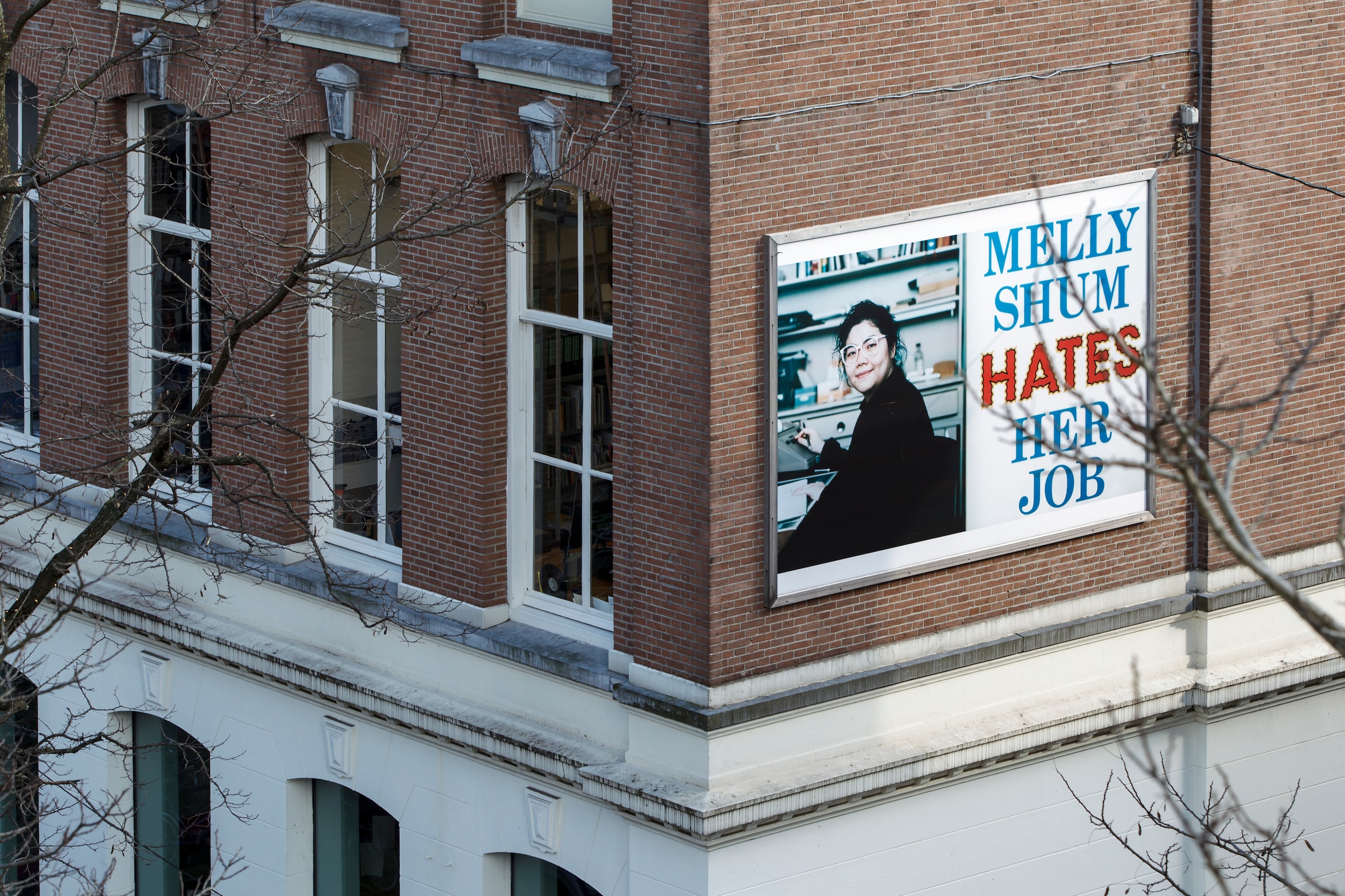
Melly Shum Hates Her Job
The public announcements around the process of this renaming fail to capture the context in which it happened. This process only took place due to immense pressure from artists and activists in Rotterdam. Only after direct action and the influence of a large-scale anti-racism movement did the institution remove its name and move forward with plans to change it.9 But this process of renaming does little to account for the institution’s failure to respond and what that delay communicates as to how seriously it might take internal concerns around equality and diversity from within the workplace. Interestingly missing from the website’s acknowledgement of its prior name10, is an accurate recounting of just how much unpaid work it took to pressure the gallery enough for them to finally relent. It’s additionally interesting to also look at how the name has been shortened. It is not Kunstinstituut Melly Shum, but just Melly. As a name, Melly is largely tied to the cultural contexts of European names, but the name Shum is often seen as romanisation of a few different southern Chinese surnames. What does it mean that one was acknowledged but not the other?11
–=–
This process happens consistently in relational dynamics. Take pet names in relationships. They remove the context of each other outside of our relations to each other. Part of this is bonding, it’s highlighting the intimacy of your intertwined context together. It’s like holding someone close. “Sweet dreams angel”12, is a regular evening mantra for many couples apart. It holds weight. It’s a small gesture of presence, even at a distance. An acknowledgement of togetherness.
The development of “idiosyncratic communication” to borrow from a popular study on the topic13, is a common part of establishing an us. A worldmaking that locks people together and helps in the building of a shared culture within the couple.14 Again, we like this context but in moderation. Sometimes an us is a helpful way of building a strong mutual support structure, but sometimes it can consume a sense of individual identity, eating at the foundations required to hold an understanding of yourself. It belays required moments of reflection and acknowledgements of past dynamics. The difficult act of processing your past. But saying, “I love you Kat” takes on a different meaning. It reaches past that shared context. It pulls on strands further reaching than just our relationship. It takes in the whole. The weight of the name holds all of the context that is embedded in that name. It becomes more than a hug.
In Jacques Derrida’s essay Aphorism Countertime, the philosopher centres names, particularly as they relate to Shakespeare’s Romeo and Julliet, as an aphorism of the self, “My name, dear saint, is hateful to myself, Because it is an enemy to thee. Had I it written, I would tear the word.” Here he identifies the infrastructure that a name represents. When one has lived with a name for any particular amount of time, it begins to hold a truth. A central pillar that holds up the context of a segment of their life. In the removal of that pillar, the context sinks down, obscuring it from view. In Romeo and Julliet both characters are bound by their context, but find liberation from it in the other. Their love doesn’t come about despite their circumstances but because of them. They cast off their names but despite this are still chained to them. Eventually believing death to be the only escape from their bindings. Ultimately, even this doesn’t free them. The play is centred on the interplay of context. Its very title describes its struggle, the dyad and the oppositional, represented through their names.
In focusing on just worldmaking, we are at risk of leaving behind parts of our context that are relevant or important to resolve. Unmaking is one part of this process but most things require something longer. A grappling with cultural context, be it class, race, gender or lineage, is integral to influencing radical and profound change. Sadly, I side with psychoanalysis in its emphasis on how our earliest experiences hold the key to current and future behaviours. This doesn’t mean forever chaining ourselves to those contexts, Fanon articulates this beautifully in Black Skin, White Masks, declaring “I am not a prisoner of history. I should not seek there for the meaning of my destiny. I should constantly remind myself that the real leap consists in introducing invention into existence. In the world through which I travel, I am endlessly creating myself”.15 But the quote articulates a man who has grappled with the history in question, it comes at the end of a book directly discussing the effects of dehumanisation on those oppressed under colonialism. Invention comes after analysis and understanding.
There is beauty in the unmaking of one’s context, a world making, however to make room for this new context, others must be unmade. This shouldn’t be missed in an analysis of this process. Destruction can be beautiful. It can be satisfying, but in it, you are still losing something. You’re still losing the world you priorly built for yourself. Deconstructing parts of the person you used to be. You’re living outside the contexts through which you’ve priorly existed. A choice that should never be made with one’s eyes shut.
24.06.2026 - living outside of context
more ->
-
The cultural practice of surnames reveals another facet of this context. European names often favour establishing the context of the father, thus establishing patriarchal systems through lineage. If we pose names as the answer to a question of identity, the question being answered by the surname in this context is “who is your father?”. ↩
-
https://www.are.na/block/43486101 ↩
-
I want to highlight that the use of ‘true’ suggests an objectivity to this process that complicates the point I’m making, especially as Le Guin relates truenames to birthname within the text. I’ll be moving between truename and birthname as synonyms but this does not suggest a sense of authority to this name over one’s chosen name. ↩
-
It’s a little more complex than this, but just read it to understand better. ↩
-
https://www.artforum.com/news/witte-de-with-center-for-contemporary-art-to-change-its-name-235623/ ↩
-
It depicts a woman of east Asian heritage, sitting at a desk, one hand on a notebook and another on a receipt printer. She gives a wired smile and the image is constructed opposite bright bold letters stating “MELLY SHUM HATES HER JOB”. As I write I have a picture of it up on my desktop and it keeps asking me questions; what does Melly think of this renaming? Did anyone care to listen to this? Allegedly she was asked her thoughts about this change at the time, however, official records come from the institution itself, so trust that as you will. Honestly, it’s a wonderful work to base a renaming after, but in this there is a repeated use of this work as an evidence of distancing, when ultimately the name wasn’t the issue, it’s what it stood for in the values of the institution. ↩
-
https://hyperallergic.com/witte-de-with-art-museum-decolonizes-name/ ↩
-
Or maybe he does? However, his choice of model, an ex-student, exists publicly within art only through the eyes of her former teacher. ↩
-
https://nltimes.nl/2020/06/12/anti-racism-graffiti-rotterdam-statues-art-center ↩
-
https://www.kunstinstituutmelly.nl/en/about#name ↩
-
https://ocula.com/magazine/spotlight/who-is-melly-shum-on-fka-witte-de-withs-name-/ ↩
-
“I love you angel” doesn’t feel natural to my relationship, though I know some people use it, but I believe my point can still be made with something that is often a stand-in for that statement. ↩
-
“‘Sweet Pea and ‘Pussy Cat’: An Examination of Idiom Use and Marital Satisfaction Over the Life Cycle,” ↩
-
https://www.scientificamerican.com/blog/mind-guest-blog/why-do-we-use-pet-names-in-relationships/ ↩
-
https://monoskop.org/images/a/a5/Fanon_Frantz_Black_Skin_White_Masks_1986.pdf ↩