Just over a year ago I started reading through Gilles Deleuze and Félix Guattari A Thousand Plateaus (1980). I never finished it. I began chronologically, but upon getting to The Geology of Morals with its stratums and substratums, I then skipped around, roughly covering maybe 5-7 chapters in total. Regardless, I loved the idea of The Body Without Organs and grabbed a loose (but useful to my own work) definition of it.
there is a lot of memes about this online
In this post I want to try to outline my understanding of The Body Without Organs, perhaps as a kind of ground level reasoning rather than anything holistic or exhaustive. I want to really highlight that this isn’t supposed to be definitive. Over the course of A Thousand Plateaus, the concept shifts and changes to embody pretty much whatever it needs to for the analogy they are making. This is more just something to maybe start with and build off of if you are working with the term for the first time or trying to make your own attempt at reading it.
To start The Body Without Organs despite its allusions to the material, is more of a lens and less of a tangible ‘thing’ or ‘infrastructure’. It operates more as a thought exercise, through which one can encounter interesting relations. The Body Without Organs is a form of open ontology. Pulling from container theory, it’s a way of gathering and understanding information. As an exercise, get a piece of blank paper and write say; land, suncream and portraits. Leave lots of space between them and lots of room at the sides.
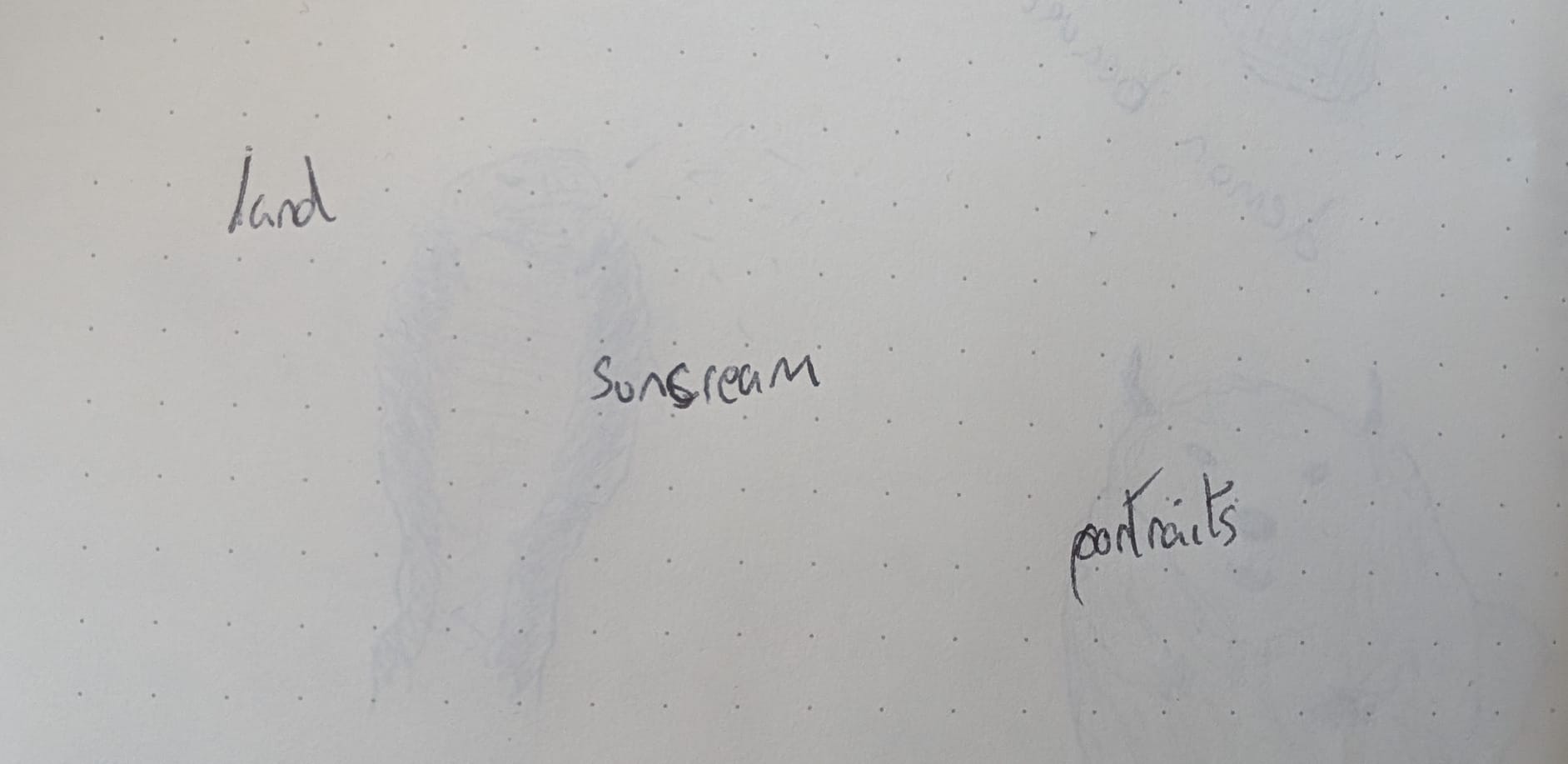
example
Now, add other elements to this page, either from what’s around you or other elements. Remove any lines or links between these data points and add yourself to the page. What you’ve formed is A Body Without Organs. A set of information, not pre formed around their relations but instead fragmentary. Now that they’ve been brought into conversation with one another, you can start building loose relationships, and through that some kind of meaning can take form. Let’s take suncream and portraits. Both are often oil based, there is an almost painterly way that sunscreen is applied and both centre somewhat around the idea of masking the self, either through interpretation or physically. We can keep going but the idea is that there is no concrete or one logic to the grouping, it’s multifacitied and open to discovery and curiosity.
A Body Without Organs is literal, it’s a structure that has no binding or core framework, something where information is prioritised equally regardless of how tangential it may be. This idea was building in contrast to the rigidity of Freudian analysis. In Freud’s conception of Psychoanalysis, everything is rooted by core archetypes (eg. the mother and the father), which then define their surroundings. But in The Body Without Organs, we want to break out of those constraints to find other connections and forms of knowledge, mimicking communism’s drive to equalise people through their labor, Deleuze and Guattari seek to equalise information in its analysis.
In The Body Without Organs, relations are not hard bindings but instead something to loosely tease out and explore. There is also no true border for this information, as it requires that one can bring anything in from outside that space and so find relationships between information already present. All conceptualisations have some form of link, but the point of this exercise is to try to shake off easy or socially constructed relations, to instead find something ‘new’. To ‘think outside the box’ so to speak. By no means is this done from a top down position, but instead, you yourself are immersed within these relations. When starting to trace faint lines between data points, you must also be able to understand your own relationship and how that might lead to how you view information. It’s far less about sitting back and viewing it like a blueprint and far more about sitting within it and feeling it out.
I like their image of the transparent map. A way of temporarily linking different concepts or ideas, without marking those relations as fixed or permanent placements on a grid. The impermanence is important here as without it, it quickly becomes its own set of predeterminate relations.
It’s a helpful exercise to do when you are feeling trapped by cultural or social contexts, to pull the information all together into one space, to let it breathe before expecting anything from it. Umberto Eco extols a similar philosophy in his book The Name Of The Rose, where his protagonist, William of Baskerville, admitting to the potential of false relations, addresses our POV character and states “ instead of conceiving only one, I imagine many, so I become the slave of none.” It’s a similar philosophy, instead of searching through information, seeking a ‘true’ relation between different data points, we can instead open ourselves to the potential of a diverse set of relations.
This interpretation is by no means holistic, or even correct. However, when dealing with philosophers like Deleuze and Guattari a productive definition or interpretation is far far more valuable than something pursuing a ‘truth’. A Thousand Plateaus famously ties itself in knots, contradicting itself or adding new qualifiers of to what ‘A Body Without Organs’ truly is. Some of these bring up other interesting questions, but the base layer - a lens through which data points are presented abstract of a hierarchy - feels an interesting enough concept. Like a field of possibilities, but one in which you are immersed rather than detached.
23.06.2026 - my body without organs