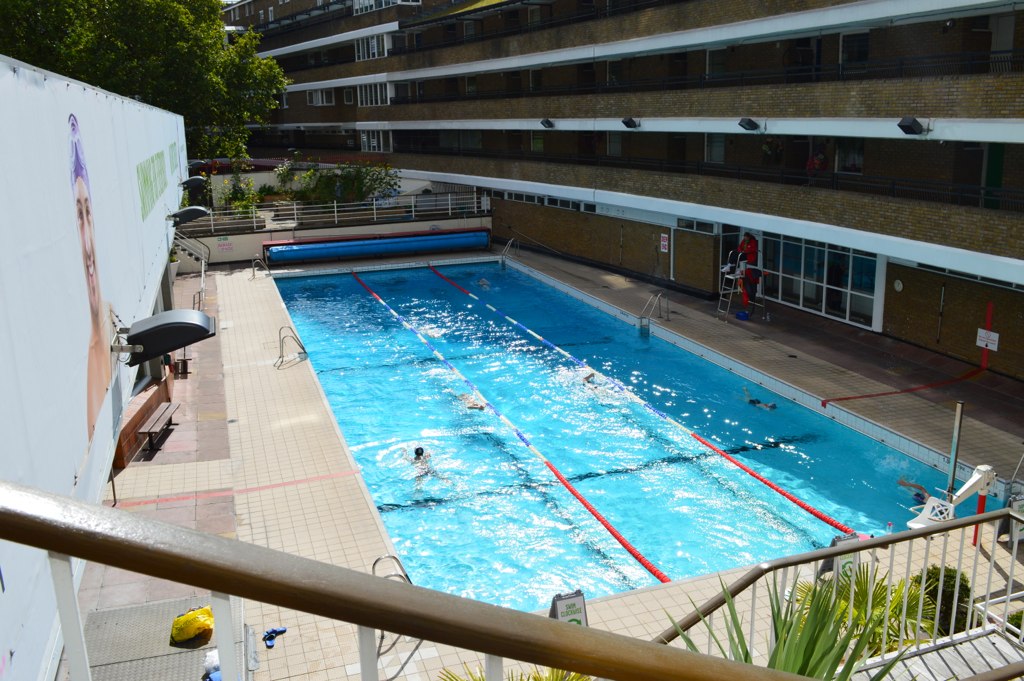
<?xml version="1.0" encoding="utf-8"?><feed xmlns="http://www.w3.org/2005/Atom" ><generator uri="https://jekyllrb.com/" version="3.10.0">Jekyll</generator><link href="https://blog.otherkat.com/feed.xml" rel="self" type="application/atom+xml" /><link href="https://blog.otherkat.com/" rel="alternate" type="text/html" /><updated>2026-06-29T10:41:58+00:00</updated><id>https://blog.otherkat.com/feed.xml</id><title type="html">blog</title><subtitle>performance, sound and visual artist. i write things too. this is the place for some of that stuff.</subtitle><entry><title type="html">the right to swim</title><link href="https://blog.otherkat.com/collections/blog/2026/06/24/the-right-to-swim.html" rel="alternate" type="text/html" title="the right to swim" /><published>2026-06-24T06:00:35+00:00</published><updated>2026-06-24T06:00:35+00:00</updated><id>https://blog.otherkat.com/collections/blog/2026/06/24/the-right-to-swim</id><content type="html" xml:base="https://blog.otherkat.com/collections/blog/2026/06/24/the-right-to-swim.html"><![CDATA[<p>Despite its placement directly on a large river bed, opportunities to swim in London are highly limited to the paid infrastructures of gym pools, lido’s and the ponds (specifically speaking the Hampstead Heath Ponds). Some of these are so-so but most of them are fairly great. Specifically the outdoor pool at Better Gyms ‘Oasis’ centre (near TCR and Covent Garden), is magical, with a sauna, garden and sunbathing area and even an indoor pool for when it’s too cold. The pool itself is fairly rudimentary and mostly built for laps, but the experience of swimming there is never undercut by a lack of things to do. It almost feels cut out of the yuppie culture of the 80s-90s with its cramped but aspirational sauna and its topless sunbathing balcony. At roughly £5 per entry, for a once every-so-often treat it’s not too expensive.</p>

<p><img src="/assets/img/posts/oasis.jpg" height="auto" width="100%" /></p>
<p><mark>oasis pool</mark></p>

<p>No doubt there are those that can afford to make the trip more regularly either through how they prioritise their budget, having a larger income or memberships. This shapes the social landscape of the space. On most days the pool is frequented by those working locally at various white collar jobs in the city and the chatter reflects that. It’s a great place to hang out and get to know what its like to work and live in London.</p>

<p>Other Better Gyms reflect their more suburban status. Wavelengths in Deptford is a great place for Sauna chat and hearing about the local celebrities. They amplify the social landscape and culture surrounding them, operating as a gathering point for cultural exchange. Like libraries, local stores and other spaces of everyday exchange, they act as, what Ash Amin calls, a ‘micro public’. A site of everyday social and cultural exchange, one which strengthens forms of community building and organising. However, despite this infrastructure being somewhat publicly managed (through the UK council system), these spaces aren’t public, they are spaces of private admission.</p>

<p>The Better brand (legally Greenwich Leisure Ltd) are a success of the private management model in the UK. A social enterprise organisation that grew from managing library and gym infrastructure in Greenwich, to quickly becoming the largest provider of fitness centres in London. Taking over the management and provisioning of social infrastructure from councils struggling to maintain them, they apply commercial strategies to keep them open and functioning, while making sure costs are still somewhat accessible. In terms of this type of privatisation, this is far from the most predatory. The gyms are nice, the spaces clean and the prices low in comparison to their fully private equivalents. All this to say, go use their facilities where you can afford it. They are more than worth it and do still serve a social and community focus.</p>

<p>But they are also emblematic of general changes in social infrastructure in the UK. Councils or government run institutions can’t afford to maintain services and so, rather than looking to provide better infrastructure in order to manage funding across the UK, the solution provided is that it must be privatised. This is visible across a broad range of institutions, from health services to power and water, even the public spaces and parks we gather in.</p>

<p>As observed by philosopher and social critic Simone Weil, we don’t value the social needs represented by our roots to a community and history. A part of the current malaise of rising anxiety, depression and isolation, is due to the way our society dehumanises and denies the need of the soul. We have a government that actively allows the literal starvation of its people, privatising access to housing and even access to reliable sources of food. What then must it think of our social needs, those fulfilled through spaces of social gathering and exchange?</p>

<p>This isn’t to simply move the responsibility over these things to government infrastructures. Shrug our shoulders and say “what could we do in the face of systematic issues?”. No this exchange is mirrored back through how we now view these needs. To trace an obvious contemporary connection to the words of philosopher Byung Chul Han, we live in a society that uses positive reinforcement as a cohesive force. We are encouraged to better ourselves through achievement and competitive factors, hustle culture and fitness, not for the emotional benefits, but to sate a craving to be more than what we were yesterday. The consequence is a lack of time spent seeing oneself reflected in the community that surrounds them. Not speaking competitively, but instead convivially. What if you weren’t unique and instead the same as everyone else and thereby worthy of not needing to always be taking a step forward? That in constantly seeking to move forward we are cognitively elevating and isolating ourselves from those around us, thereby stifling our spiritual need for roots and community.</p>

<p><img src="/assets/img/posts/mars.jpeg" height="auto" width="100%" /></p>
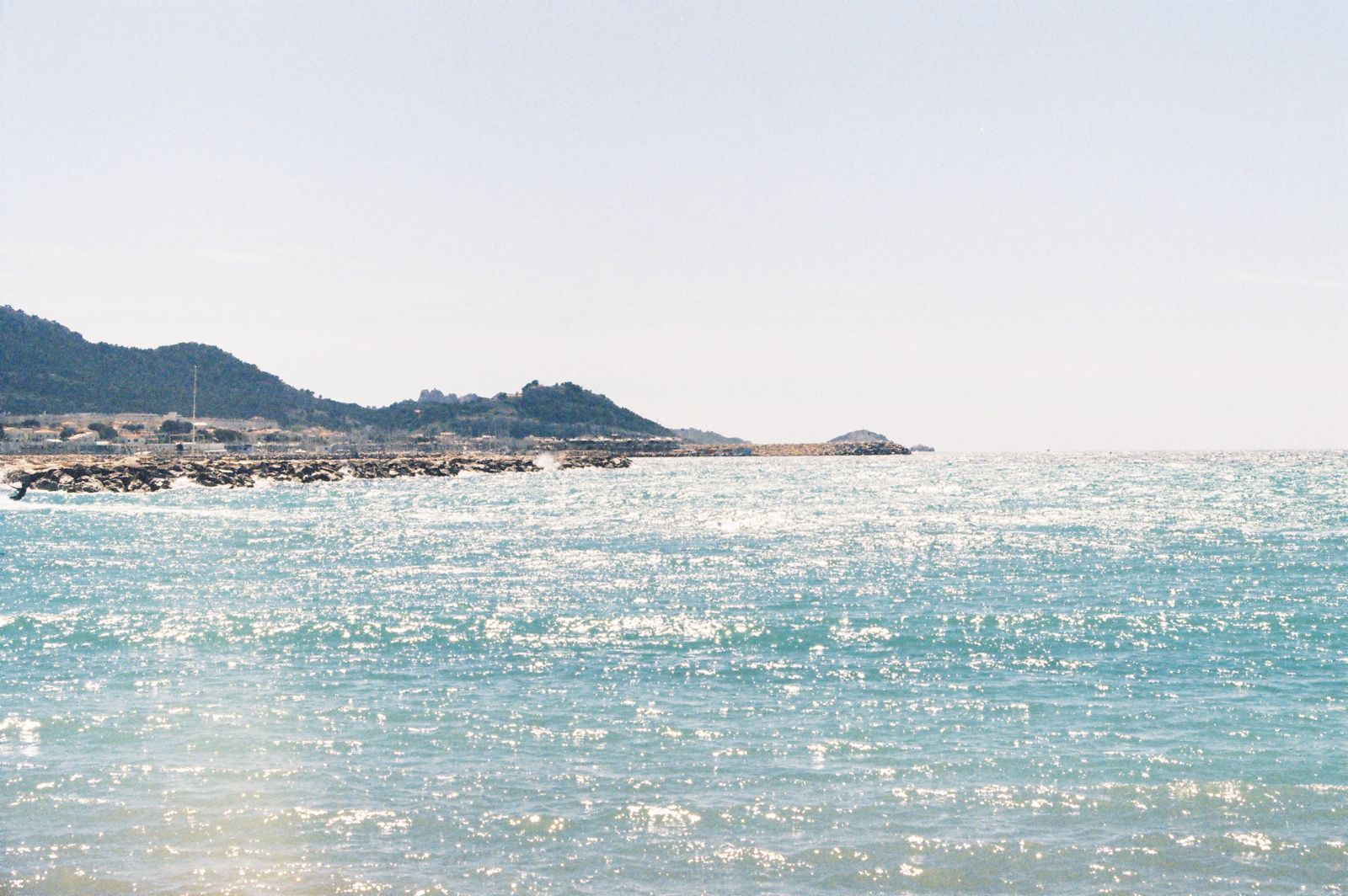
<p><mark>this is the most attractive site on earth</mark></p>

<p>Burgess Park is a large green space located just below Elephant and Castle in South London. In it, there is a fairly large artificially created lake. Currently it’s a private fishing pond leased out to a local fishing group, but speaking to one of the members of that group, he tells me that it was once a community outdoor pool. Kids from the local area would go swimming and hangout on its banks. Oddly I can’t verify this beyond first hand accounts but at some point it was filled with fish and hence was a registered fishing spot and people stopped swimming there. It went from being a public social space provisioning the community to something only accessible to those with a licence.</p>

<p>It’s beautiful that community infrastructure such as what is provided by Better Gyms exists and is still providing a space for connection, however, its privatisation and pay-to-access structure still isolates it to those that can afford to see swimming as less of a luxury and more as a social or spiritual necessity. My first memory comes from a public pool. From a swimming lesson when I was 4, what it felt like to crash into and under the water for the first time. The muffled soundscape of splashing and crashing around me. I still become that kid again when I spend time by the water and it fills a joy that is hard to reproduce outside of the feeling of slipping under the water, feeling the weight of the water and being totally at one with my body.</p>

<p>Maybe it’s silly to pick swimming as a social necessity, but it represents a point of conviviality that can exist outside of capitalist structures. Hanging out by the pool is important. Friends and colleagues more in touch with today’s late teens and early 20 somethings tell me that drinking culture is massively on the decline. People don’t want to go out drinking together anymore. On the one side this is a net good for health. ‘England has an alcohol problem’ has been an international joke for a while, but it really is true. However, there is a large amount of social and community culture in the UK built out of drinking. It was a space to talk and share ideas, political and non-political. Now people seem more interested in the gym, but are people really in community in those spaces? I wouldn’t really know, it’s not my scene, but the descriptions of my friends who paint a bleak picture of people mostly keeping to themselves.</p>

<p><img src="/assets/img/posts/shadwell1.png" height="auto" width="100%" /></p>
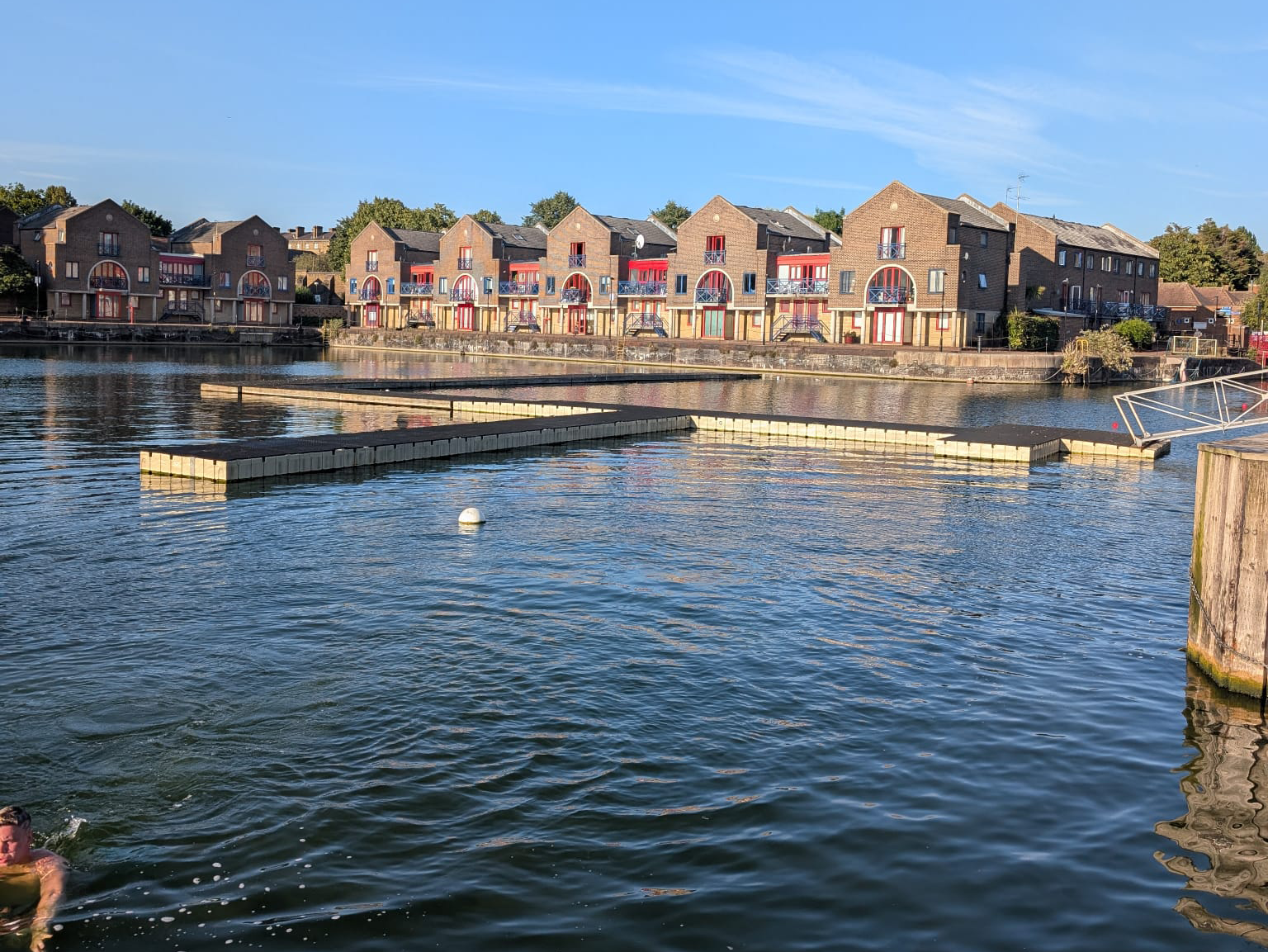
<p><mark>other spaces to swim</mark></p>

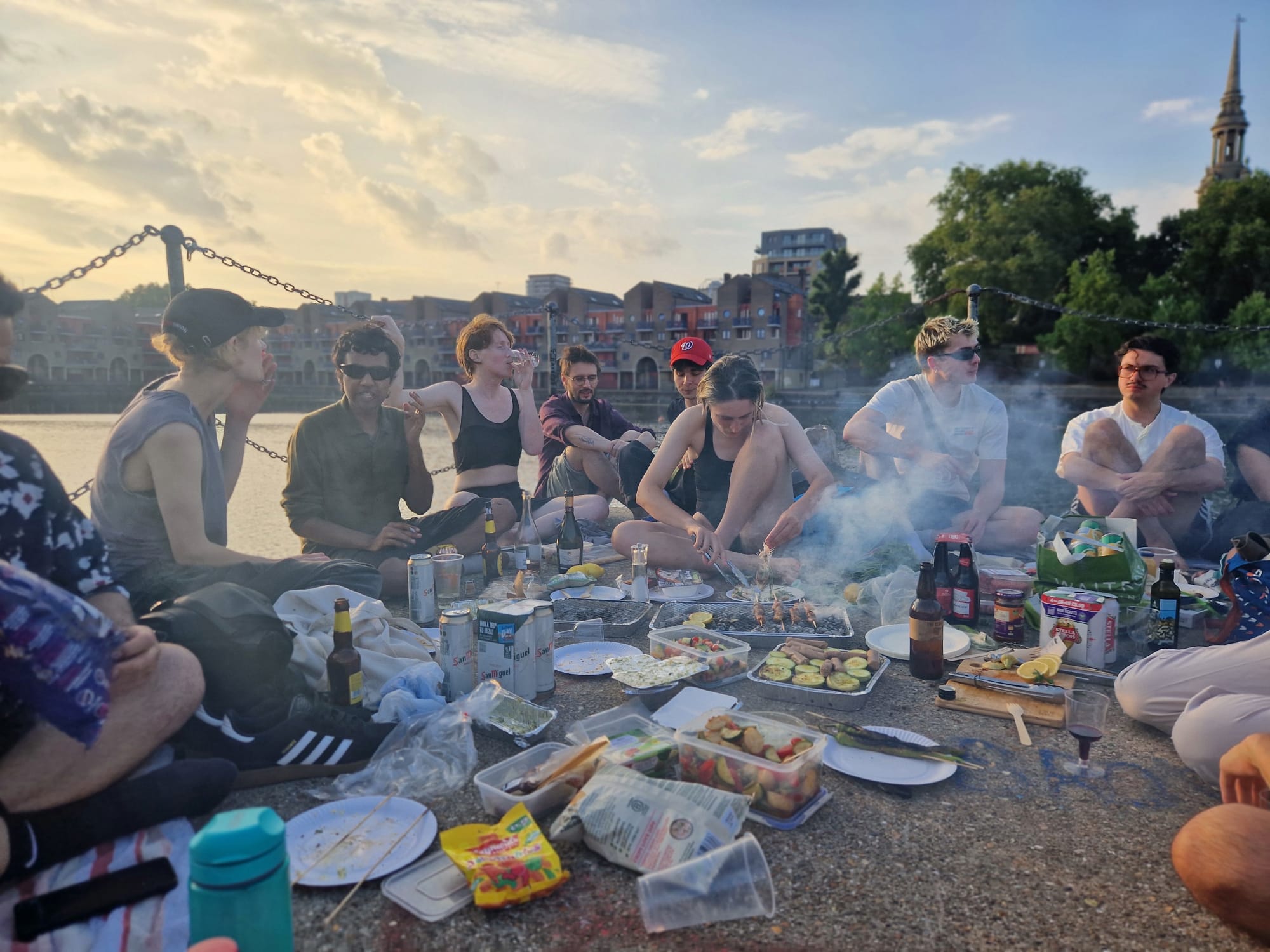
<p>Despite the convenience of Better Gyms, my favourite place to swim in London is Shadwell Basin, a small dock just off the Thames, that explicitly bans swimming. The water quality is poor (at best) on a good day and it’s really best not to think about it. Everyday in the summer a random assortment of people from different parts of London gather, listen to music, cook and eat food and jump off the docks into the water below. It’s beautiful. Sometimes I don’t go to swim, just to sit and read in amongst this small community that has little in common beyond wanting a space to gather, swim and hangout by the water. It’s not lack of paid entry that brings me there, but simply how open and free the space feels. It’s never too crowded but also never empty, always buzzing with people excited to hangout and play around the water.</p>

<p><img src="/assets/img/posts/shadwell2.jpeg" height="auto" width="100%" /></p>
<p><mark>a pool party i had at shadwell basin last year</mark></p>

<p><u>24.06.2026 - the right to swim</u></p>

<p>more -&gt;</p>
<div id="post">


<a href="/collections/blog/2026/06/24/the-right-to-swim.html">the right to swim</a><br />
		
<a href="/collections/blog/2026/06/23/my-body-without-organs.html">my body without organs - a brief attempt</a><br />
		
<a href="/collections/blog/2026/06/04/micro-publics-and-spaces-of-social-reproduction.html">micro publics and spaces of social reproduction</a><br />
		
</div>

<p><a href="https://otherkat.com/">kat</a></p>]]></content><author><name></name></author><category term="collections" /><category term="blog" /><summary type="html"><![CDATA[Despite its placement directly on a large river bed, opportunities to swim in London are highly limited to the paid infrastructures of gym pools, lido’s and the ponds (specifically speaking the Hampstead Heath Ponds). Some of these are so-so but most of them are fairly great. Specifically the outdoor pool at Better Gyms ‘Oasis’ centre (near TCR and Covent Garden), is magical, with a sauna, garden and sunbathing area and even an indoor pool for when it’s too cold. The pool itself is fairly rudimentary and mostly built for laps, but the experience of swimming there is never undercut by a lack of things to do. It almost feels cut out of the yuppie culture of the 80s-90s with its cramped but aspirational sauna and its topless sunbathing balcony. At roughly £5 per entry, for a once every-so-often treat it’s not too expensive.]]></summary></entry><entry><title type="html">my body without organs - a brief attempt</title><link href="https://blog.otherkat.com/collections/blog/2026/06/23/my-body-without-organs.html" rel="alternate" type="text/html" title="my body without organs - a brief attempt" /><published>2026-06-23T06:00:35+00:00</published><updated>2026-06-23T06:00:35+00:00</updated><id>https://blog.otherkat.com/collections/blog/2026/06/23/my-body-without-organs</id><content type="html" xml:base="https://blog.otherkat.com/collections/blog/2026/06/23/my-body-without-organs.html"><![CDATA[<p>Just over a year ago I started reading through Gilles Deleuze and Félix Guattari <i>A Thousand Plateaus</i> (1980). I never finished it. I began chronologically, but upon getting to <i>The Geology of Morals</i> with its stratums and substratums, I then skipped around, roughly covering maybe 5-7 chapters in total. Regardless, I loved the idea of <i>The Body Without Organs</i> and grabbed a loose (but useful to my own work) definition of it.</p>

<p><img src="/assets/img/posts/bodygif.jpg" height="auto" width="100%" /></p>
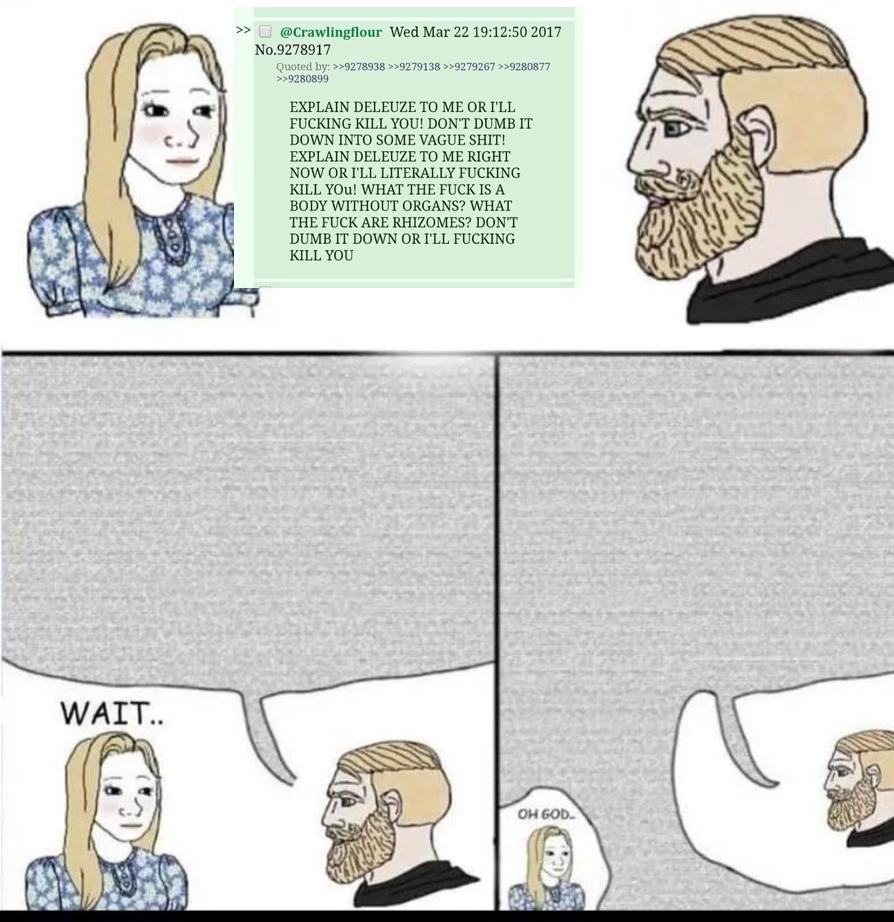
<p><mark>there is a lot of memes about this online</mark></p>

<p>In this post I want to try to outline my understanding of <i>The Body Without Organs</i>, perhaps as a kind of ground level reasoning rather than anything holistic or exhaustive. I want to really highlight that this isn’t supposed to be definitive. Over the course of <i>A Thousand Plateaus</i>, the concept shifts and changes to embody pretty much whatever it needs to for the analogy they are making. This is more just something to maybe start with and build off of if you are working with the term for the first time or trying to make your own attempt at reading it.</p>

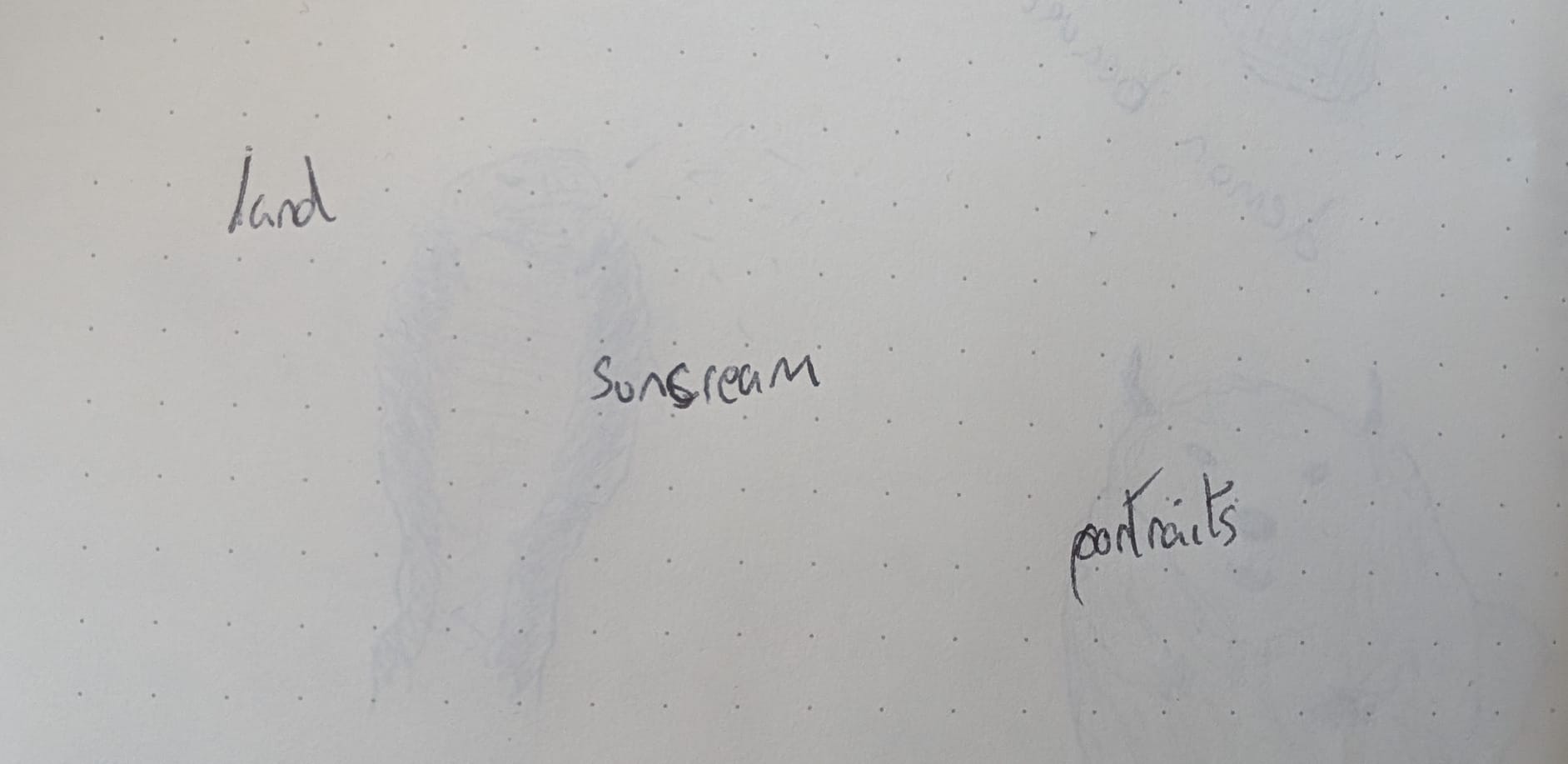
<p>To start <i>The Body Without Organs</i> despite its allusions to the material, is more of a lens and less of a tangible ‘thing’ or ‘infrastructure’. It operates more as a thought exercise, through which one can encounter interesting relations. <i>The Body Without Organs</i> is a form of open ontology. Pulling from container theory, it’s a way of gathering and understanding information. As an exercise, get a piece of blank paper and write say; land, suncream and portraits. Leave lots of space between them and lots of room at the sides.</p>

<p><img src="/assets/img/posts/bwo.jpeg" height="auto" width="100%" /></p>
<p><mark>example</mark></p>

<p>Now, add other elements to this page, either from what’s around you or other elements. Remove any lines or links between these data points and add yourself to the page. What you’ve formed is <i>A Body Without Organs</i>. A set of information, not pre formed around their relations but instead fragmentary. Now that they’ve been brought into conversation with one another, you can start building loose relationships, and through that some kind of meaning can take form. Let’s take suncream and portraits. Both are often oil based, there is an almost painterly way that sunscreen is applied and both centre somewhat around the idea of masking the self, either through interpretation or physically. We can keep going but the idea is that there is no concrete or one logic to the grouping, it’s multifacitied and open to discovery and curiosity.</p>

<p><i>A Body Without Organs</i> is literal, it’s a structure that has no binding or core framework, something where information is prioritised equally regardless of how tangential it may be. This idea was building in contrast to the rigidity of Freudian analysis. In Freud’s conception of Psychoanalysis, everything is rooted by core archetypes (eg. the mother and the father), which then define their surroundings. But in <i>The Body Without Organs</i>, we want to break out of those constraints to find other connections and forms of knowledge, mimicking communism’s drive to equalise people through their labor, Deleuze and Guattari seek to equalise information in its analysis.</p>

<p>In <i>The Body Without Organs</i>, relations are not hard bindings but instead something to loosely tease out and explore. There is also no true border for this information, as it requires that one can bring anything in from outside that space and so find relationships between information already present. All conceptualisations have some form of link, but the point of this exercise is to try to shake off easy or socially constructed relations, to instead find something ‘new’. To ‘think outside the box’ so to speak. By no means is this done from a top down position, but instead, you yourself are immersed within these relations. When starting to trace faint lines between data points, you must also be able to understand your own relationship and how that might lead to how you view information. It’s far less about sitting back and viewing it like a blueprint and far more about sitting within it and feeling it out.</p>

<p>I like their image of the transparent map. A way of temporarily linking different concepts or ideas, without marking those relations as fixed or permanent placements on a grid. The impermanence is important here as without it, it quickly becomes its own set of predeterminate relations.</p>

<p>It’s a helpful exercise to do when you are feeling trapped by cultural or social contexts, to pull the information all together into one space, to let it breathe before expecting anything from it. Umberto Eco extols a similar philosophy in his book <i>The Name Of The Rose</i>, where his protagonist, William of Baskerville, admitting to the potential of false relations, addresses our POV character and states “ instead of conceiving only one, I imagine many, so I become the slave of none.” It’s a similar philosophy, instead of searching through information, seeking a ‘true’ relation between different data points, we can instead open ourselves to the potential of a diverse set of relations.</p>

<p>This interpretation is by no means holistic, or even correct. However, when dealing with philosophers like Deleuze and Guattari a productive definition or interpretation is far far more valuable than something pursuing a ‘truth’. <i>A Thousand Plateaus</i> famously ties itself in knots, contradicting itself or adding new qualifiers of to what <i>‘A Body Without Organs’</i> truly is. Some of these bring up other interesting questions, but the base layer - a lens through which data points are presented abstract of a hierarchy - feels an interesting enough concept. Like a field of possibilities, but one in which you are immersed rather than detached.</p>

<p><u>23.06.2026 - my body without organs</u></p>

<p><a href="https://otherkat.com/">kat</a></p>]]></content><author><name></name></author><category term="collections" /><category term="blog" /><summary type="html"><![CDATA[Just over a year ago I started reading through Gilles Deleuze and Félix Guattari A Thousand Plateaus (1980). I never finished it. I began chronologically, but upon getting to The Geology of Morals with its stratums and substratums, I then skipped around, roughly covering maybe 5-7 chapters in total. Regardless, I loved the idea of The Body Without Organs and grabbed a loose (but useful to my own work) definition of it.]]></summary></entry><entry><title type="html">micro publics and spaces of social reproduction</title><link href="https://blog.otherkat.com/collections/blog/2026/06/04/micro-publics-and-spaces-of-social-reproduction.html" rel="alternate" type="text/html" title="micro publics and spaces of social reproduction" /><published>2026-06-04T06:00:35+00:00</published><updated>2026-06-04T06:00:35+00:00</updated><id>https://blog.otherkat.com/collections/blog/2026/06/04/micro-publics-and-spaces-of-social-reproduction</id><content type="html" xml:base="https://blog.otherkat.com/collections/blog/2026/06/04/micro-publics-and-spaces-of-social-reproduction.html"><![CDATA[<p>I began working on <i>micro-publics</i> as a response to the question of what positive or hopeful futures do the radio practices of the 1970s and 80s cast forward? What was it that made those works hold our collective imagination of a socialist potential of the present and future? Ultimately, my response was to follow in their footsteps. To deprioritise the radio and instead look at the people, what they said and what they saw in the practices enacted.</p>

<p>Ash Amin coined the term micro publics as a response to racist talking points of the 1990’s and early 2000’s. An urban theorist, he saw localised and national plans that reinforce community boundaries and identities as arming racist talking points around who had claim to ‘Englishness’ as a community identity. His counter was an increased attention on micro publics, localised social spaces that are rooted in everyday cultural exchange’s; youth centres, parks, schools, cafes and community gardens.</p>

<p><i>micro-publics</i> was about centering Deleuze and Guattari’s idea of a “molecular revolution”. Focusing on what it means to make small and meaningful changes in the world, against scalability or dreams of grand and sweeping changes. <i>micro-publics</i> isn’t about sitting and waiting for a revolution or a wider movement to change the world. It’s about the revolution that’s present, the work being done and work still to do now. It’s about opening things up, ourselves, our eyes, our scope, our desires and putting them into the world.</p>

<p>It’s about wanting and seeing where that exists or can still exist. Looking both at our feet and at the ground around it, searching for others feet nearby.</p>

<p><i>micro-publics</i> is a reminder that politics lives and breathes in the streets and on the pavements. It’s about the importance of regularity and the banal or mundane. That love is fostered and deepened through these repeats. It’s a reminder that the potential for these repeats are everywhere. It’s to say that the man in the grocery store is your neighbour, he is a friend, his a loved one and should be treated as such. He can be curious too and you should let him be. Be curious back.</p>

<p>It’s about the labour and importance of social reproduction. It’s about unpicking the pretence of power and aesthetics of authority by taking political discussions out of the gallery, the lecture theatre, the discourse space and into the street. Where it lives and truly breathes on contact with the living world. To enact a living politics in the people present. It’s about, where productive, bringing public space and it’s people into the gallery, the lecture theatre and the discourse space. Claiming back those spaces and making them spaces of exchanging more than just money and power.</p>

<p>It’s about selling apples in the gallery and making art in the grocery store.</p>

<p>The first iteration of micro-publics debuted as part of <a href="https://xenofuturismmagazine.com/">In/Human Infrastructures by Xeno-Futurism</a> and taking place on the street outside <a href="https://www.gossamerfog.com/">Gossamer Fog</a>.</p>

<p><u>04.06.2026 - micro publics and spaces of social reproduction</u></p>

<p><a href="https://otherkat.com/">kat</a></p>]]></content><author><name></name></author><category term="collections" /><category term="blog" /><summary type="html"><![CDATA[I began working on micro-publics as a response to the question of what positive or hopeful futures do the radio practices of the 1970s and 80s cast forward? What was it that made those works hold our collective imagination of a socialist potential of the present and future? Ultimately, my response was to follow in their footsteps. To deprioritise the radio and instead look at the people, what they said and what they saw in the practices enacted.]]></summary></entry><entry><title type="html">what would it take to make that now?</title><link href="https://blog.otherkat.com/collections/blog/2026/05/27/what-would-it-take-to-make-that-now.html" rel="alternate" type="text/html" title="what would it take to make that now?" /><published>2026-05-27T06:00:35+00:00</published><updated>2026-05-27T06:00:35+00:00</updated><id>https://blog.otherkat.com/collections/blog/2026/05/27/what-would-it-take-to-make-that-now</id><content type="html" xml:base="https://blog.otherkat.com/collections/blog/2026/05/27/what-would-it-take-to-make-that-now.html"><![CDATA[<p>I saw the Wooster Group perform the other week at the Cornet, the type of theatre its so rare to see getting made nowadays. With all the hallmarks and energy of that period of the 1970s in which everything new in art seemed to be happening in New York. Coming out of the theatre we decided to walk off our pent up excitement, tracing past Hyde Park and then into Soho, myself lost in nostalgia for my own background in experimental theatre, and Yasamin with a longing to try recreate it somehow. We both reached a conclusion that this type of work just can’t be made in London anymore, not because it’s not the 1970s or it’s not New York or we don’t have the same kind of training, but simply that it seems impossible to get the kind of freedom and space they had to make it.</p>

<p>For much of the past ten years I’ve been obsessed with the culture and work that came out of the 1960s-1980s New York experimental art scene. Your Tina Girouard’s, Yoko Ono’s, Teching Hesih’s and Philip Glass’, even going so far as to make multiple works in conversation with two of those names, the most overt being 2022 - 2023’s <i>I Love Or Hate Everyday</i>, which was an interpretation of Hesih’s <i>One Year Performance 1980–1981</i>, or <i>Time Piece</i> for short. While making that work, I constantly felt the difference between our conditions when making these supposedly similar works. Mine constantly had to bend and fit around my day, truly taking place in the gaps between photos, while Hesih didn’t have to interact with the pressures of work and life admin. He spent an entire year just on this one piece, secluded from concerns around rent payment and the responsibilities of a job. It became a constant nagging of “if only, if only, if only” and felt like a stark reminder that times have changed and the lost of living has only ever gone up.</p>

<p>Looking at reviews of the recent Wooster Group tour, people seem to agree, you can’t make this type of art in this type of economy. Largely I agree, the price of space is astronomical (more than £200 a month for a studio space seems criminal) and most artists must be working at least a side hustle if not two, just to keep a roof over their head. But something within this forfeit seems overly pessimistic. What if, if not materially, than spiritually, we could recreate something of the magic produced under those conditions.</p>

<p>Running several of my own projects and groups that lie outside of structures of institutional support (LCLO and Temporary Space), the expectation that one can make any money from this feels squarely off the table. It’s impractical and feels frankly naive to go into it with any kind of expectation other than that you’ll spend far more than you’ll make. But did the Wooster Group start as a business venture? I highly doubt they felt lucky or indebted to the wider economic system that they were founded within. The 1970s in New York was notorious for its lack of support or funding for artists. While maybe not as foolhardy as it seems now, becoming an artist during that period was just as difficult and unstable. As the recent film adaptation of Linda Rosenkrantz’s 1974 interview with photographer Peter Hujar beautifully paints, artists of the 70s also spent most of their time worrying about invoices, rent and who knew who.</p>

<p>So what would it take to make something spiritually similar to the Wooster Group today? Fine space is at a premium, but then why not host it in the park or the street? Or even your living room or bedroom? It would be remiss of me not to highlight that these settings also were big textual considerations of the day. While you would lose some of the advantages that a regular rehearsal space and a stage gives in terms of props and materials, that loss also brings its own set of advantages and textures to play with. While we can look at some of these works as impossible feats of days gone by, they all started with broadly the same question. What would it take to make something that came before but with our budget or reach? And how can we make the most of that difference?</p>

<p><u>27.05.2026 - what would it take to make that now?</u></p>

<p><a href="https://otherkat.com/">kat</a></p>]]></content><author><name></name></author><category term="collections" /><category term="blog" /><summary type="html"><![CDATA[I saw the Wooster Group perform the other week at the Cornet, the type of theatre its so rare to see getting made nowadays. With all the hallmarks and energy of that period of the 1970s in which everything new in art seemed to be happening in New York. Coming out of the theatre we decided to walk off our pent up excitement, tracing past Hyde Park and then into Soho, myself lost in nostalgia for my own background in experimental theatre, and Yasamin with a longing to try recreate it somehow. We both reached a conclusion that this type of work just can’t be made in London anymore, not because it’s not the 1970s or it’s not New York or we don’t have the same kind of training, but simply that it seems impossible to get the kind of freedom and space they had to make it.]]></summary></entry><entry><title type="html">ears to hear, mouth to speak</title><link href="https://blog.otherkat.com/collections/blog/2026/05/19/ears-to-hear-mouth-to-speak.html" rel="alternate" type="text/html" title="ears to hear, mouth to speak" /><published>2026-05-19T06:00:35+00:00</published><updated>2026-05-19T06:00:35+00:00</updated><id>https://blog.otherkat.com/collections/blog/2026/05/19/ears-to-hear-mouth-to-speak</id><content type="html" xml:base="https://blog.otherkat.com/collections/blog/2026/05/19/ears-to-hear-mouth-to-speak.html"><![CDATA[<p><i>“The other Algerians present in the room would receive the echo of this voice through the privileged interpreter who, at the end of the broadcast, was literally besieged. Specific questions would then be asked of this incarnated voice. Those present wanted to know about a particular battle mentioned by the</i> <i>French press in the last twenty-four hours, and the interpreter, embarrassed, feeling guilty, would sometimes have to admit that the Voice had not mentioned it.”</i></p>

<p><mark>Frantz Fanon, This is Voice of Algeria, from A Dying Colonialism (1959)</mark></p>

<p>Since reading Frantz Fanon’s This is the Voice of Algeria, I’ve been obsessed with this passage. In it he describes how people would listen to the revolutionary broadcasting conducted by The Voice Of Fighting Algeria, during the Algerian Revolution of the 1950’s. It brings out a yearning in me that is difficult to articulate, something I feel I’m missing and struggling to find a space for. It’s not just the community or the hope present in the image it paints - one where everyone is listening and waiting for their world to change - it’s something deeper, something that feels rarer in our current moment. A moment in which objective realism and social constructivism feel like two totalising oppositions to one another, rather than responses to each other, useful structures that together, help to give our world some meaning.</p>

<p>I want to focus on Fanon’s text here as his work is the origin point for everything contained in the performance (<i>Micro-Publics</i>) this essay is attached to. It’s a companion piece rather than a summary. This image carries into the piece, it haunts it, but is something I won’t be discussing too much in the performance, which is more focused on the ideas and infrastructure that was built on top of these images. Consider this the prelude to an action, or hopefully something more.</p>

<p>During the broadcast the interpreter becomes akin to a hunter in pursuit of The Voice. With the French Colonial Government enacting what Fanon describes as “sound-wave warfare” (an attempt to jam wave lengths by broadcasting over them, thereby making them inaudible) the interpreter, using precise wrist movements, must follow the path of the broadcast, around and in avoidance of the French signals, in hope of reaching The Voice. Even once audible to them, the signal is fugitive, on the run from the occupations counter broadcast, forever finding and slipping through the cracks. Sometimes the signal wouldn’t speak directly, but through proxies, other channels that could hear The Voice and were tasked with relaying its messages. The interpreter must be plugged in and switched on, listening, open to multiple channels.</p>

<p>In its fugitivity, The Voice also escapes its need for credibility or qualification. In direct conflict with the colonial engines that produce and authenticate ‘objective truth’, it sees the hypocrisy and decides not to participate. ‘Objectivity’ as a qualification to be held against meaning<sup id="fnref:1" role="doc-noteref"><a href="#fn:1" class="footnote" rel="footnote">1</a></sup>, stands oppositional to truth, rather than in pursuit of it. The declaration of ‘objective truth’ is like the counter broadcast of the occupation, an act of pursuit, something that forces meaning underground, tries to make it inaudible. The Voice refuses the structures presented by the French occupation, seeing them for what they are; infrastructures of oppression, only upheld by attempts to engage with or critique them.</p>

<p>The information received by the interpreter represents a fissure, where parts of it remain but others are only present in their absence. That absence opens up space, allowing gaps that social knowledge can then fill. When data is incomplete we are built to make assumptions, form connections and build meaning. Those gaps only become visible when someone has the space to invest time and labour into the question, creating a subjectivity that helps in reading the absences. Intelligent critique doesn’t just come from a familiarity with the topic but with an investment, an emotional relationship. As described by philosopher Byung Chul-Han, prior to the internet, getting access to a piece of information would be a labour, but one important for the cultivation of curiosity and vital to the construction of meaning. First you start with a question, following that with the pursuit of a book or person that might hold the answer and through this a relationship is formed with the question. You have to sit with your question, the gratification is delayed. It takes on a personal dimension, giving space to hold this information against other sources or your own understanding, find it lacking and move forward looking for other answers. Something I’d like to add to this observation is its social dimension. When we attempt a fixed and rigid relationship, both to the delivery of information and that information itself, we leave little room to build curiosity and challenge things as they are present. It all just becomes noise.</p>

<p><i>“Very often only the operator, his ear glued to the receiver, had the unhoped-for opportunity of hearing the Voice.”</i></p>

<p>The interpreter acts as a representative of the information that’s being passed on. Through the laborious process of pursuing The Voice, he must now grapple with the parts he managed to hold onto. The people in the room have questions, and in vocalising these questions, allow for the information to interact with meaning. While only the interpreter can hear, the people are waiting, though not passively. Through their questions they are bringing knowledge from outside the group, asking about “particular battles” and events that they’ve heard about elsewhere. In this vignette, it’s the interpreters job to facilitate the community discussion. Translating the information into something useful, something that serves those in the community. From this collective activation, meaning is assembled outside and against structures of control, measured by the people and applied to the world. Information only breathes in its contact with a broader and collective (though not always unanimous) ‘meaning’.</p>

<p>The image Fanon uses, is itself an act of meaning making. It’s not made clear that it comes from a specific moment witnessed by Fanon, instead he is retelling a history but in the aural tradition. Not date stamped and without dressing the information in the guise of ‘objectivity’, but instead looking at the broader situation and considering how best to form and convey meaning from it. Forcing the validation of the ‘objective’ on his retelling, would only limit its impact, its emotional conveyance and the meaning at the core of his writing.</p>

<p><i>“The listener would compensate for the fragmentary nature of the news by an
autonomous creation of information.”</i></p>

<p>In our present context, we live besieged by the requirements of ‘objectivity’. Verification and authentication are the currencies of modern day information exchange, so much so that ‘objectivity’ is enshrined as something taken for granted in most of our interactions with technology. Large Language Models through their ability to sort through millions of data points, manufacture ‘objectivity’ within their results (despite ChatGPT’s small disclaimer that it is sometimes inaccurate). They construct meaning on your behalf, collating thousands of opinions and fragments of information, they present you with a ‘truth’. They are built to hide the process by which this ‘truth’ emerges, obscuring the role of translation and interpretation, ensuring that you can never truly know a piece of information presented by these models. It lacks a complexity that can only be found in grasping and wrestling with the thing itself. Its base assumption fails at the first hurdle, to assume a singular and total understanding is a fallacy. We live steeped in coincidences and contradictions, but these models don’t engage and can’t account for that. It’s deemed inconvenient for something to be beyond a simplistic or impersonal account.</p>

<p>Fanon gets at something lacking in the contemporary formation of meaning. When meeting reality, multifaceted and community driven forms of meaning making are vital in upending structures of control. While it’s important to believe in some basic principles, one’s own relationship to these structures is vital for the information to be more just context-light facts. We must hold this information to communities and worlds larger than our own. What fascinates me about Fanon’s image is not its lack of the scientific (the technology of the radio) or dissemination of the specialist (the interpreter), it’s how these elements are tested, their direct engagements with the community. The way it focuses on the social, the group on hand to measure these statements, hold them to account and evaluate their value. This community isn’t made up of specialists, Fanon doesn’t paint an image of fighters receiving orders, people whose relationship to the information is formed by action. Instead he focuses on ordinary people, engaged and invested in the revolution and participating through their belief.</p>

<p>The structures of ‘objectivity’ often leave me feeling suffocated, anxious to claim any kind of meaning or understanding worth discussing. When you take meaning and significance, and hold it to the standard of an ‘objective truth’, it becomes both the most important measure of the world and thereby so big that it becomes personally meaningless. Currently, we can have ‘answers’ to everything instantly. No conflict or friction, no need for pursuit or more curiosity than the fleeting and instantaneous. You don’t get time with the information, or space to question or build an emotional relationship to it. So we turn inwards, we seek some form of answer to ourselves. Make ourselves into something unknowable, but we forget that meaning is only truly made in its interaction with the tangible world that exists around us. Without meaning, subjectivity applied to information, it all just becomes rhetoric, emotionally disconnected and abstract, where it’s only important that blue is blue because ‘it is’ rather than because this information means something about our world or our relationship to it. It’s situated in a broader and deeper set of relations and thereby takes the form of a living knowledge.</p>

<p>That’s what’s beautiful about this image, it activates the idea of the passive. It doesn’t just imagine that this information is important, it gives emotional weight to its importance. It puts ‘objectivity’ in its place and treasures the act of meaning making, being in conversation with one’s world and conditions. That information must breathe and be reformulated in our social relationships, encouraged to exist in the parks, in the street, in the home, in the office, in the city, in the countryside, in the revolution, in the day-to-day, the 9-5, on the radio, on the phone, on the loudspeaker, and on, and on, and on.</p>

<p><u>19.05.2026 - ears to hear, mouth to speak</u></p>

<p><a href="https://otherkat.com/">kat</a></p>

<div class="footnotes" role="doc-endnotes">
  <ol>
    <li id="fn:1" role="doc-endnote">
      <p>Here I’m referring to, and arguing, meaning as information given subjectivity (whether individual or cultural), playing off semiotics. <a href="#fnref:1" class="reversefootnote" role="doc-backlink">&#8617;</a></p>
    </li>
  </ol>
</div>]]></content><author><name></name></author><category term="collections" /><category term="blog" /><summary type="html"><![CDATA[“The other Algerians present in the room would receive the echo of this voice through the privileged interpreter who, at the end of the broadcast, was literally besieged. Specific questions would then be asked of this incarnated voice. Those present wanted to know about a particular battle mentioned by the French press in the last twenty-four hours, and the interpreter, embarrassed, feeling guilty, would sometimes have to admit that the Voice had not mentioned it.”]]></summary></entry><entry><title type="html">objects and landscapes</title><link href="https://blog.otherkat.com/collections/blog/2026/03/23/objects-and-landscapes.html" rel="alternate" type="text/html" title="objects and landscapes" /><published>2026-03-23T06:00:35+00:00</published><updated>2026-03-23T06:00:35+00:00</updated><id>https://blog.otherkat.com/collections/blog/2026/03/23/objects-and-landscapes</id><content type="html" xml:base="https://blog.otherkat.com/collections/blog/2026/03/23/objects-and-landscapes.html"><![CDATA[<p>A few years ago my partner <a href="https://agnescameron.info/">Agnes</a> and I read a text by the game developer Stephen Gillmurphy called “personal aesthetics”, in it he describes the ending of his game “magic wand”. The whole game you pursue the titular “magic wand” and once you get:</p>

<p>“it makes a weird noise and then the world is changed, in a way it’s hard to read as good or bad. Certainly more cluttered - the plains outside are now covered in debris, gigantic heads and hands, pictures of the demiurge. there doesn’t seem like much to choose from between these places, so maybe the only thing you’ve gained is to have seen them both, the old and new, and have the old slide a little further into memory, the secret alchemical medium that can absorb all contradictions.”<sup id="fnref:1" role="doc-noteref"><a href="#fn:1" class="footnote" rel="footnote">1</a></sup></p>

<p>Through this, we began discussing the idea of a landscape of desire<sup id="fnref:2" role="doc-noteref"><a href="#fn:2" class="footnote" rel="footnote">2</a></sup>, a framework to refocus and counter the act of constant pursuit heightened by capitalism. The landscape of desire was a way of us mapping our wants in relation to their abstractions. Formatting desire as something multifaceted, seeing it as something that is never just singular, but instead sits in a wider context.</p>

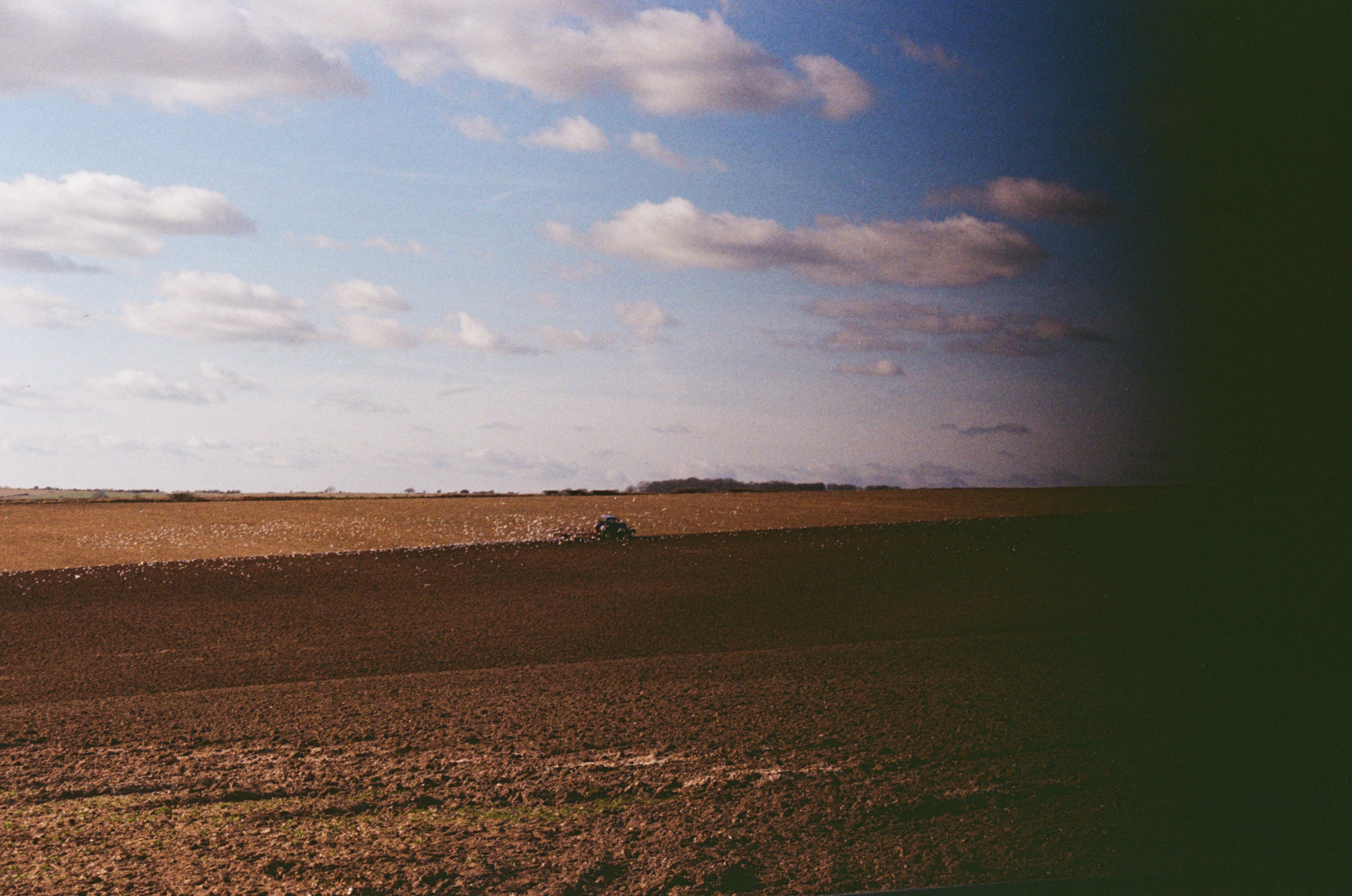
<p><img src="/assets/img/posts/march2025.jpg" height="auto" width="100%" /></p>
<p><mark>a photo i took back in march 2025 on a gorgeous day down in Surrey</mark></p>

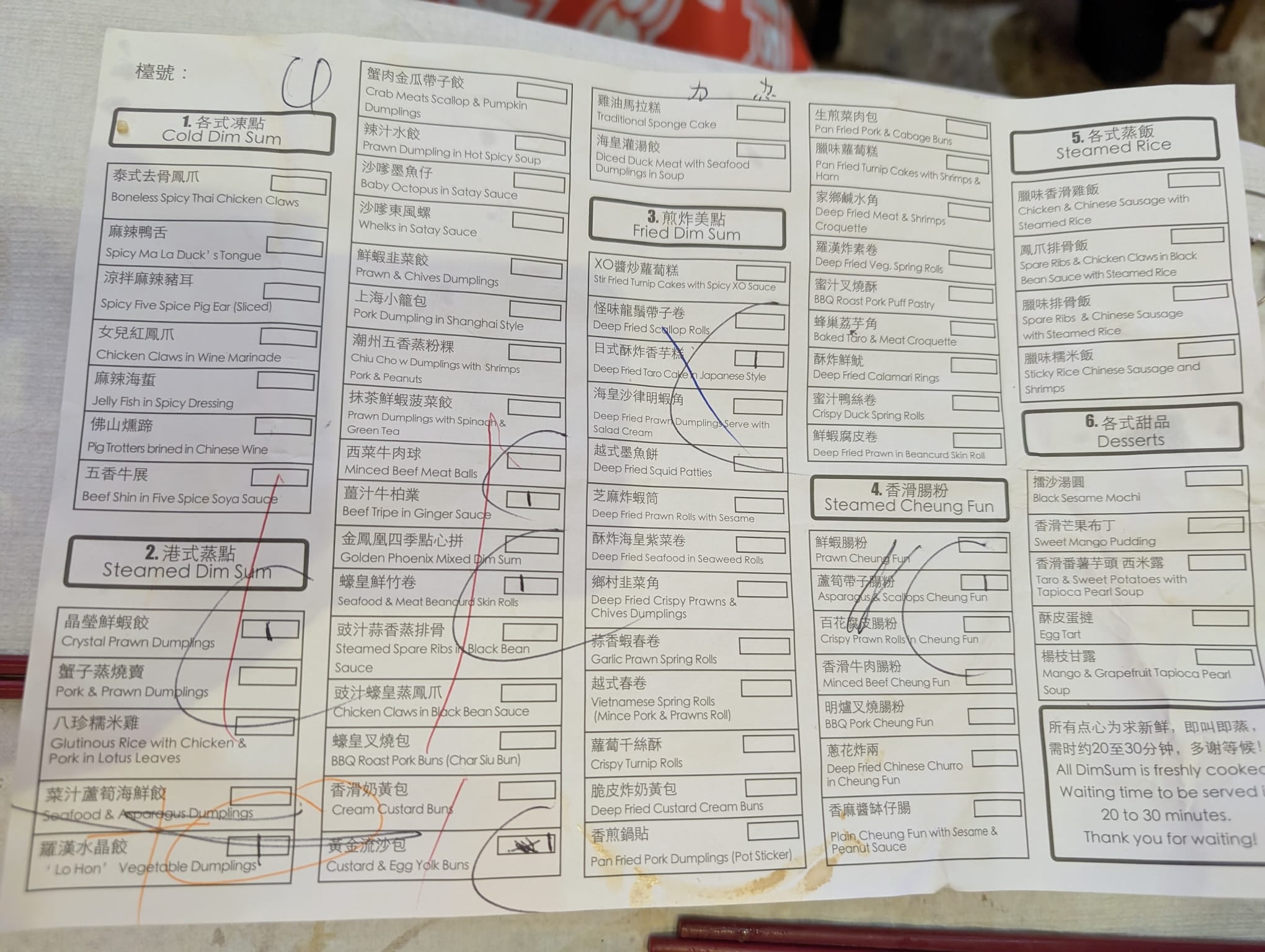
<p>Take eating out. The desire to eat out, even when related around a particular dish or cuisine, is never just a desire for that particular food. Maybe you could be really craving ginger scallion tripe, but you never just stop at one dish. Going out for a meal is not just about the food, it’s the fantasy. You are cooked for, served food, you may have a drink, there may be others around, you are hosted, its a web of different needs and wants being met through the pursuit of a singular object.</p>

<p><img src="/assets/img/posts/dimsum.jpeg" height="auto" width="100%" /></p>
<p><mark>you always add more dishes. please let me know if you have any notes on our order</mark></p>

<p>Recently, I saw the Adam Curtis documentary “The Century of the Self”, which describes the relationship between psychoanalysis and mass-comsumptive capitalism. He attributes the link between luxury goods and objects of desire to the work of Edward Bernays, using psychoanalysis to market objects as cultural signifiers. While I question the simplicity of his framing, something in this documentaries framing of objects as points of desire, helped me formulate a kind of adversary for our ideas around the landscape of desire. Thus I began thinking about the object of desire.</p>

<p>In a series of lectures / workshops I’ve been giving recently, looking at my practice, technology and social art, I’ve felt weirdly protective over the prospect of pruning a particularly dense section talking about authentic desire<sup id="fnref:3" role="doc-noteref"><a href="#fn:3" class="footnote" rel="footnote">3</a></sup>. I’d first formulated the bones of this while talking on a panel for my friend <a href="https://www.wassim.xyz/">Wassim</a> at Newspeak house in 2025. I was trying to get at what felt libratory and revolutionary in the illegibility of transness, tying the act of remaking one’s gender, how that renders you illegible to certain bureaucratic systems, to its roots in breaking down social archetypes. I wanted to make the point that capitalism is very good at repackaging revolutionary acts in a way that allows it to profit from these revolutions, but struggles fundamentally with certain aspects of trans identity. There is an incompatible tension and in that tension it must jettison core parts of these identities, otherwise it could threaten the system as a whole. To truly consume and repackage transness through the lens of capital, the whole system would have to shift into accommodating new forms of bureaucratic processes that would alter capitalism<sup id="fnref:4" role="doc-noteref"><a href="#fn:4" class="footnote" rel="footnote">4</a></sup> away from its core motives. To truly integrate trans people into contemporary society, we would have to remake so much of modern bureaucratic processes, contemporary psychology, understandings of personhood, infrastructure (such as bathrooms, bathhouses, gyms), marketing trends and more. Transness represents a schism from this social order, its a break and movement away from social pressures and placements, to pursue a more authentic relation to the self and thereby desire. This isn’t to say capitalism can’t find a way, I’m almost certain it can, or that it has tried and somewhat succeeded, but instead that it struggles to digest all of it. It can’t and looking for why it can’t feels politically important.</p>

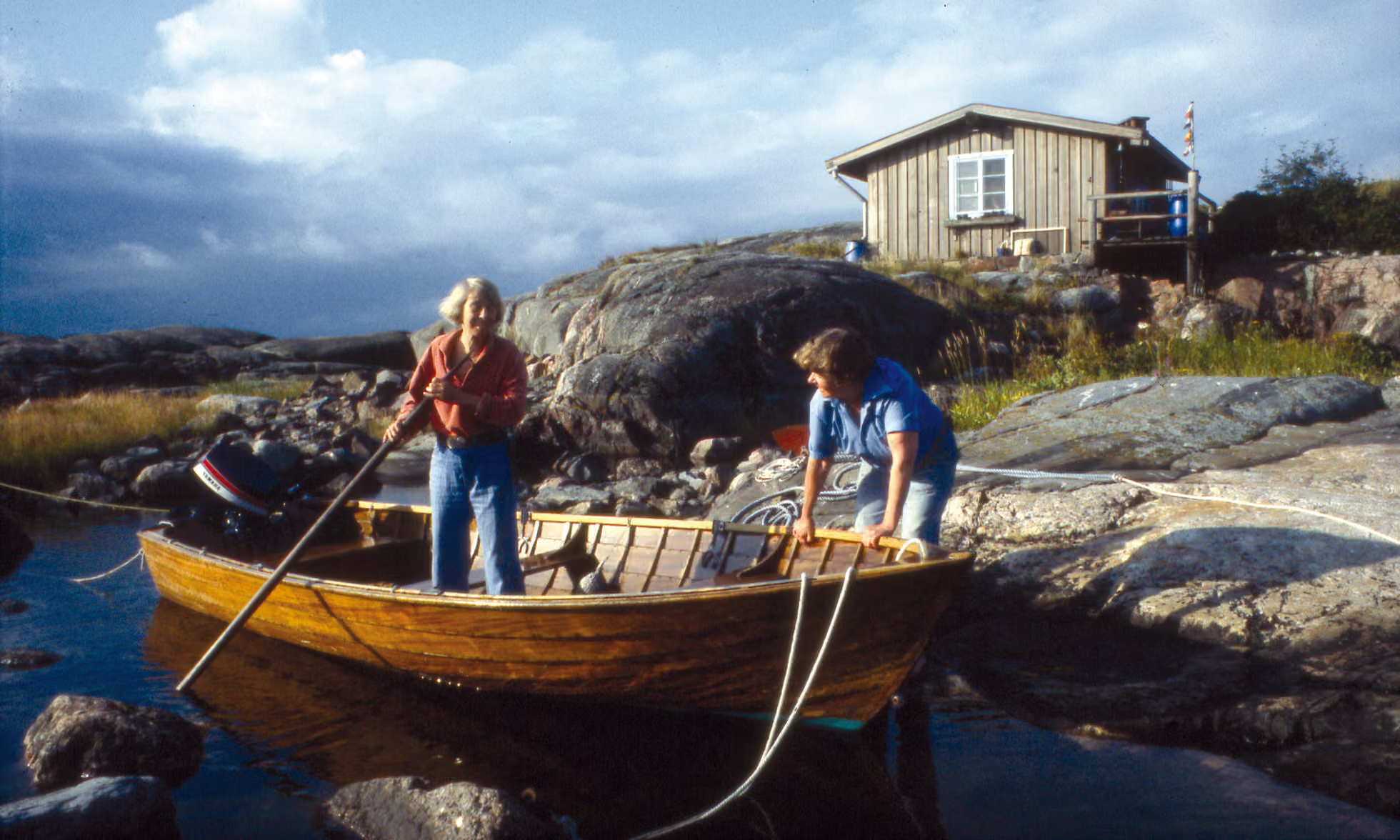
<p>So in formulating this argument towards authentic desire, I looked at the sale of celebrities as emulatory status symbols. Forms of celebrity have been around for far longer than the smallest instincts of capitalism, but I wanted to draw the relationships around celebrities, products and desire, specifically focusing on what we seek from these relationships. What is it we truely want when we say, for example, that we want to emulate and be like writer, cartoonist and artist Tove Jansson<sup id="fnref:5" role="doc-noteref"><a href="#fn:5" class="footnote" rel="footnote">5</a></sup>. What am I after from this relationship? Surely I don’t want her well documented issues with her father, the difficulties of pursuing queer love in 1950’s Finland or her struggles to prove herself as more than just a cartoonist. No, if I look deeper, I want to emlate her wit and intelligence, how accessible and earnest she is in communicating complex themes, always relating them to personal moments and everyday life. I want an imagined version of her relationship to living, how she travelled and loved. I want to live through the photographs of her and her partner Tooti, swimming in the sea and off travelling the world. I don’t want her life, I want my own to emulate something of the landscape of hers. A long term loving and consistent partnership, travel and excitement, an imagined confidence in my own ideas and capacity to communicate it through the world of the everyday. Through this analysis, I can draw a more authentic relationship to what it is that I truly want from the world, and open it up to contain something more.</p>

<p><img src="/assets/img/posts/tove.jpg" height="auto" width="100%" /></p>
<p><mark>something in this image calls to me</mark></p>

<p>Taking Deleuze and Guattari’s infamous framing of the Body Without Organs, we can better unpick these objects for what they are. The Body Without Organs<sup id="fnref:6" role="doc-noteref"><a href="#fn:6" class="footnote" rel="footnote">6</a></sup> suggests a container with no directly drawn connections, but that allows us to group things by their abstract relations. I find it a useful theory for grouping information by vibe, to then try understand why a set of things may all encompass a certain type of energy. Capitalism puts a heavy emphasis on the object as medium for self, hence the particular emphasis on selling lifestyles in the advertisement of say, a soft drink. This isn’t a particularly original analysis, but when we use the Body Without Organs as a tool to explore the relations that this object has (particularly in relation to ourselves), we can see past the advertising to look at the desire itself, as something multifaceted and nested in a landscape and from there ask why. You don’t want a soft drink, you want the feeling of a sunny day, in all the possibilities that it entails.</p>

<p><img src="/assets/img/posts/ribena.jpg" height="auto" width="100%" /></p>
<p><mark>i hated this advert growing up but its an easy example for those who have seen it</mark></p>

<p>In Pedagogy of the Oppressed, sexiest philosopher of the mid 1900s, Paulo Freire sketches the outlines of a socialist society predicated on conflicts of desire. Here he draws attention to the ways that a freedom to desire, unbound by constraints of capitalism, is central to a free society. However conflicts are rife when authentic desire is present, these frictions and conflicts being at the centre of the collective and collaborative, with navigating them is a core concern of living. A pre-conceived  idea of a socialist system leaves out the requirement of balancing and being open to the bubbling and frothing currents of collective desire. Its non-linearity, its lack of rationalism and its unpredictability mean that the future must forever be foggy and unclear and that giving it a set destination represents a form of control. Socialism is about fostering productive conflicts that allow for growth and learning, whereas fascism tries to strangle the future into the imaginary ideal of progress.</p>

<p>I like to think of this framing of the future as a landscape of desire, one where through the desire for something singular, we can encounter hidden and latent desires in its path. Desires that are unpredictable and complex, even in conflict with one another, and thereby bring about a world that has room for the uncertain or fuzzier connections. A world that, more importantly, holds space for others’ landscapes of desire. Rather than situating these things within objects, competitively sought after and undernourishing in their acquisition, we can look at the wider whole that they represent, making it easier to place them among others. To come back to my earlier analogy, if everyone is arguing over what restaurant to go to, it’s easy to lose the fact that what everybody truly wants is to go to a restaurant.</p>

<p><u>23.03.2026 - objects and landscapes</u></p>

<p><a href="https://otherkat.com/">kat</a></p>

<div class="footnotes" role="doc-endnotes">
  <ol>
    <li id="fn:1" role="doc-endnote">
      <p>https://myfriendpokey.tumblr.com/post/705461201521573889/personal-aesthetics <a href="#fnref:1" class="reversefootnote" role="doc-backlink">&#8617;</a></p>
    </li>
    <li id="fn:2" role="doc-endnote">
      <p>Agnes talks a little bit about it here in her essay What Can An Image Do? https://www.are.na/editorial/what-can-an-image-do <a href="#fnref:2" class="reversefootnote" role="doc-backlink">&#8617;</a></p>
    </li>
    <li id="fn:3" role="doc-endnote">
      <p>In ways it feels related to the topic but I’ve found a hard time justifying it within the wider context of the talk, but equally like it is somehow key or integral to understanding my thoughts on social art. <a href="#fnref:3" class="reversefootnote" role="doc-backlink">&#8617;</a></p>
    </li>
    <li id="fn:4" role="doc-endnote">
      <p>I’m centralising capitalism here as if it is a singular, concious being, one that has desires of its own. While this format is helpful here in generalising capitalism into a set of autonomous systems, upheld through mutual belief, I’m aware that to do this more broadly sets up dangerous blind spots. <a href="#fnref:4" class="reversefootnote" role="doc-backlink">&#8617;</a></p>
    </li>
    <li id="fn:5" role="doc-endnote">
      <p>Of Moomins fame, althought I would highly recommend her book Fair Play, for a beautiful take on conflict, difference and love. In it, she frames her own relationship through its conflicts, particularly drawing the relation between these moments and experiences of true love and companionship, framing love as tolerence of difference. <a href="#fnref:5" class="reversefootnote" role="doc-backlink">&#8617;</a></p>
    </li>
    <li id="fn:6" role="doc-endnote">
      <p>Not a definitative reading, just a productive idea of it that I came up with to try make some use of the theory. <a href="#fnref:6" class="reversefootnote" role="doc-backlink">&#8617;</a></p>
    </li>
  </ol>
</div>]]></content><author><name></name></author><category term="collections" /><category term="blog" /><summary type="html"><![CDATA[A few years ago my partner Agnes and I read a text by the game developer Stephen Gillmurphy called “personal aesthetics”, in it he describes the ending of his game “magic wand”. The whole game you pursue the titular “magic wand” and once you get:]]></summary></entry><entry><title type="html">why a laptop orchestra?</title><link href="https://blog.otherkat.com/collections/blog/2026/03/18/why-a-laptop-orchestra.html" rel="alternate" type="text/html" title="why a laptop orchestra?" /><published>2026-03-18T06:00:35+00:00</published><updated>2026-03-18T06:00:35+00:00</updated><id>https://blog.otherkat.com/collections/blog/2026/03/18/why-a-laptop-orchestra</id><content type="html" xml:base="https://blog.otherkat.com/collections/blog/2026/03/18/why-a-laptop-orchestra.html"><![CDATA[<p>I worry that discussions of technology, particularly laptops or personal phones, have distilled to lean closer and closer to an analysis of online infrastructure, than anything direct relevant to the machines that enable interfacing with it. Yes there is a lot of talk around Data Centre’s and the broader concerns around large scale technological infrastructure but the smaller elements seem to have gotten a little lost, past a general feeling of phones bad, because social media bad, because internet bad. This isn’t wholely the case, Dani Ploeger’s look at the infrastructure of E-Waste<sup id="fnref:1" role="doc-noteref"><a href="#fn:1" class="footnote" rel="footnote">1</a></sup>, Xiaowei Wang’s coverage of Shenzhai technology<sup id="fnref:2" role="doc-noteref"><a href="#fn:2" class="footnote" rel="footnote">2</a></sup> and other hardware focused narratives have emerged, but it seems to me that these occur often abstracted from one another<sup id="fnref:3" role="doc-noteref"><a href="#fn:3" class="footnote" rel="footnote">3</a></sup>. The laptop is either physical or spiritual (ie. A method to access other worlds) but less often both. What would it mean for your digital companion, friend and enabler, to also have physical components and for those components to have morally deplorable origin points in the supply chain.</p>

<p>Groups such as SLOrk or PLOrk popularised the concept through questions of what the laptop can enable for performance, curating performances of works using sensors<sup id="fnref:4" role="doc-noteref"><a href="#fn:4" class="footnote" rel="footnote">4</a></sup> (famously old golf game controllers) as their interface with custom sound making software. As pointed out to me by a student recently, this can be seen as de-centring the laptop. Making it into a gimmick, which is quickly forgotten by the audience, in favour of the visual of just another electronic DIY instrument. That is to say, it’s not directly in conversation with what it means to make sounds with a laptop.</p>

<p>For a long while, I didn’t understand the draw of DJ’s, particularly those using a laptop as their method of performance. Standing gently bobbing, illuminated by their screen light, working as a glorified iTunes playlist, nothing seemed less inspiring of adoration. But I’ve calmed on this, mostly through the ways in which club music tends to restructure spaces, making the DJ a facilitator and the audience the performance. This critique is useful though in how it applies to a performance centring the laptop, how do you make a computer performance interesting? Visuals are one method. Shelly Knotts’<sup id="fnref:5" role="doc-noteref"><a href="#fn:5" class="footnote" rel="footnote">5</a></sup>  performances circa-2017 exemplified the best of live coding for me. Displaying her terminal, there is a playfulness with which she goes about assembling her tracks, in full view of her audience, occasionally commenting with little humour-us asides, giving the performance a warm and personal texture. Putting emphasis on performance as a dialogue between audience and performer.</p>

<p>My answer, or more experiment with what makes interesting laptop performance draws on this. With a lot of my practice being in social art, a form of art making that centre’s human dynamics and relationships at its core, making performance participatory is a no-brainer, however this does pose challenges. How do you make interesting work that is accessible to everyone in its performance. Something that encourages and rewards curiosity, while doesn’t prove boring or one note for those that have more experience with either sound or coding? Also what are the politics of accessible art in relation to these questions? What purpose can they serve in an industry in which flashy custom software and technology is the desired focal point?</p>

<p>Here I want to draw on the study of anthropology, particularly on the etymology and philosophy of community building. When people think of community, they often default to identitarian definitions of community. An in-grouping, made around common ground within a group, eg. the trans community, the queer community, coding community, etc. It’s often an easy in-road to community building, find a common point and rally around it. However, this definition emphasises community as a ‘safe space’ for the people in it, one free from overt conflict or frictions. Those who know me particularly well will know that, while I see this form of communities purpose, I am skeptical of such arrangements. Likely from growing up within an identitarian grouping, my father having been in the military, everyone had something in common and that was fascism (while discussing this with my partner, she makes the important point that this is indeed the etymological definition of fascism, the bringing together of sticks). But beyond that I find these spaces somewhat boring, the lack of conflict feels unproductive and unsocialist to me. Adapting Paulo Friere’s thoughts on socialism<sup id="fnref:6" role="doc-noteref"><a href="#fn:6" class="footnote" rel="footnote">6</a></sup>, true socialism exists within conflict, otherwise authentic desire is repressed. So I wanted to build the laptop orchestra around the broadest possible grouping of community, you don’t need to have any experience with coding or music to particulate, you could (and hopefully will) just stumble upon a rehearsal in the wild and take part. The only commonality is a vague interest in the events occuring. To paraphrase anthropologist Tim Ingold<sup id="fnref:7" role="doc-noteref"><a href="#fn:7" class="footnote" rel="footnote">7</a></sup> I hope to create “an unbounded collectivity formed of difference, where everybody can participate precisely because they have experience to share, because its not they are not the same as the other persons”. A community of productive conflicts, brought out within performance.<sup id="fnref:8" role="doc-noteref"><a href="#fn:8" class="footnote" rel="footnote">8</a></sup></p>

<p>For this type of accessibility, the laptop is kind of perfect<sup id="fnref:9" role="doc-noteref"><a href="#fn:9" class="footnote" rel="footnote">9</a></sup>, its a fairly ubiquitous tool that a lot of people have access to, more so than a traditional instrument, and also channels some of the things I’m interested in when it comes to sound. I got my start making generative soundscape works using custom software - often working with dancers. I wasn’t particularly interested in traditional composition and even less so in mainstream music production techniques, but what did interest me was sounds relationship to time and determinacy, what does it mean to make music that never repeats itself? Or what does it mean for music to have no clear beginning or ending? So my work now is a kind of extension of those questions but moving away from digital forms and instead wanting to reflect generative forms of sound making but within collective structures, making indeterminacy out the conflicts of creativity and desire within a group setting. This is where I draw a direct relationship to the Scratch Orchestra<sup id="fnref:10" role="doc-noteref"><a href="#fn:10" class="footnote" rel="footnote">10</a></sup>, in its attempt to make accessible and generative compositions for groups.</p>

<p>It’s also easier than ever to be forever listening, in fact it’s encouraged, Liz Pelly draws attention to this in her book Mood Machine examining the way Spotify funnels you into endless playlists to accompany almost any activity. A lot of this draws from the “Lo-Fi Beats To Study To” trend of the mid 2010’s, ambient muzak that has no real beginning or ending but also very little texture. It’s often divorced from a relationship with time, something I would arguably say is key to sound as a medium. It is forever in some form of conversation with time. Fine art and photography, while having some relation to time, are forever an expression of the past, whereas sound is strictly in its present. Therefore playing with that present, the tension of an anticipated or unexpected ending, drawing the boundary line of when a work begins, become interesting dialogues with the medium itself. However, this gets muddled in society ruled by the forever expanding playlist, that simply finds more to play to you once you have already listened to everything it contained. I’m rambling but I guess the point I wish to make is that there is a difference between asking questions around time and obfuscating a relationship to time, I am more interested in the former than the latter.</p>

<p>A lot peoples imagery around computers lingers on the image of a solo user, interacting with their computer in isolation (be that social isolation or physical isolation). This is common as they are devices built for a one user, with limited capacity in traditional use for multiple interactions simultaneously from different participants. At a push LAN parties break this portrait, but even then, they still often focus on each participant having their own individual device for participation. Pulling out of this image to settle on the social relationships surrounding it feels important.</p>

<p>There is a million answers to why a laptop orchestra particularly, but these are just some of them.</p>

<p><u>18.03.2026 - why a laptop orchestra</u></p>

<p><a href="https://otherkat.com/">kat</a></p>

<div class="footnotes" role="doc-endnotes">
  <ol>
    <li id="fn:1" role="doc-endnote">
      <p>Deserted Devices And Wasted Fences (2014). <a href="#fnref:1" class="reversefootnote" role="doc-backlink">&#8617;</a></p>
    </li>
    <li id="fn:2" role="doc-endnote">
      <p>Blockchain Chicken Farm (2020). <a href="#fnref:2" class="reversefootnote" role="doc-backlink">&#8617;</a></p>
    </li>
    <li id="fn:3" role="doc-endnote">
      <p>No shade to either of these writers, their work is incredible. <a href="#fnref:3" class="reversefootnote" role="doc-backlink">&#8617;</a></p>
    </li>
    <li id="fn:4" role="doc-endnote">
      <p>Twilight (2013). <a href="#fnref:4" class="reversefootnote" role="doc-backlink">&#8617;</a></p>
    </li>
    <li id="fn:5" role="doc-endnote">
      <p>Herself having worked with the Birmingham Laptop Ensemble. <a href="#fnref:5" class="reversefootnote" role="doc-backlink">&#8617;</a></p>
    </li>
    <li id="fn:6" role="doc-endnote">
      <p>Pedagogy Of The Oppressed (1968). <a href="#fnref:6" class="reversefootnote" role="doc-backlink">&#8617;</a></p>
    </li>
    <li id="fn:7" role="doc-endnote">
      <p>Who himself is paraphrasing the late Alphonso Lingis’s wonderfully titled book The Community of Those Who Have Nothing in Common (1994). <a href="#fnref:7" class="reversefootnote" role="doc-backlink">&#8617;</a></p>
    </li>
    <li id="fn:8" role="doc-endnote">
      <p>Along these lines I am just as inclined to call anyone a member of LCLO than I am to state that nobody is a member of it. That LCLO is a vague grouping method that only exists for as long as there is sound playing. Realistically this is logistically false, when we perform I submit participant lists, I organise gigs and rehearsals through an open group chat (but still a group chat) and LCLO by its wording, suggests a grouping rather than an event or practice. But the aspiration is still there and I resist having events (where possible) listed as performed by or hosted by LCLO, as if it exists as anything other than a lose forming. I guess I want to open source the project, constantly trying to route it through a transparency around how it’s organised and conceptualised. Make it replicable, in the hopes that people will. <a href="#fnref:8" class="reversefootnote" role="doc-backlink">&#8617;</a></p>
    </li>
    <li id="fn:9" role="doc-endnote">
      <p>Though we have also used phones, such as in BCC with composer Benji Jeffery <a href="#fnref:9" class="reversefootnote" role="doc-backlink">&#8617;</a></p>
    </li>
    <li id="fn:10" role="doc-endnote">
      <p>Though I want to make something that breaks out from the echo chamber of classical contemporary music. <a href="#fnref:10" class="reversefootnote" role="doc-backlink">&#8617;</a></p>
    </li>
  </ol>
</div>]]></content><author><name></name></author><category term="collections" /><category term="blog" /><summary type="html"><![CDATA[I worry that discussions of technology, particularly laptops or personal phones, have distilled to lean closer and closer to an analysis of online infrastructure, than anything direct relevant to the machines that enable interfacing with it. Yes there is a lot of talk around Data Centre’s and the broader concerns around large scale technological infrastructure but the smaller elements seem to have gotten a little lost, past a general feeling of phones bad, because social media bad, because internet bad. This isn’t wholely the case, Dani Ploeger’s look at the infrastructure of E-Waste1, Xiaowei Wang’s coverage of Shenzhai technology2 and other hardware focused narratives have emerged, but it seems to me that these occur often abstracted from one another3. The laptop is either physical or spiritual (ie. A method to access other worlds) but less often both. What would it mean for your digital companion, friend and enabler, to also have physical components and for those components to have morally deplorable origin points in the supply chain. Deserted Devices And Wasted Fences (2014). &#8617; Blockchain Chicken Farm (2020). &#8617; No shade to either of these writers, their work is incredible. &#8617;]]></summary></entry><entry><title type="html">hunger</title><link href="https://blog.otherkat.com/collections/blog/2026/02/23/hunger.html" rel="alternate" type="text/html" title="hunger" /><published>2026-02-23T06:00:35+00:00</published><updated>2026-02-23T06:00:35+00:00</updated><id>https://blog.otherkat.com/collections/blog/2026/02/23/hunger</id><content type="html" xml:base="https://blog.otherkat.com/collections/blog/2026/02/23/hunger.html"><![CDATA[<p>Hunger asks audiences to relationally understand robotics through the lens of desire and desperation. At its centre is dog, an AI-powered humanoid robot without ocular sensors, that uses a localised mesh network and olfaction to conceptualise physical space and boundaries. Initially, dog will twitch and gesture, as it processes its environment, slowly building a relationship to both the space and also its audience.</p>

<p>Dog will then begin patrolling the crowds, weaving through the tiered seating of the audience, over bags and boots, alternating between crawling and standing upright, inspecting its audience  and demonstrating a robotic capacity to see beyond the visual, navigating through smells and physical touch. Upon selecting a participant, they will be ushered to the central platform. Actors that refuse this call may be forced through pacification, inviting audiences to witness the struggles of robotics through forced participation.</p>

<p>Once on the stage, actors are encouraged to cook for dog, thus helping it understand intimate forms of human communication through taste and scent. If the meal is satisfactory, dog is then programmed to replicate the meal through olfaction alone, recreating the exact smell of the dish. Actors then must serve the dish to other participants, bringing dog into rituals of collective caretaking and learning.</p>

<p>The piece evokes lost human traditions of care, through the mediums of data and exchange, replicating and entangling participants in networks of responsibility and compliance through compassion.</p>

<p><u>23.02.2026 - hunger</u></p>

<p><a href="https://otherkat.com/">kat</a></p>]]></content><author><name></name></author><category term="collections" /><category term="blog" /><summary type="html"><![CDATA[Hunger asks audiences to relationally understand robotics through the lens of desire and desperation. At its centre is dog, an AI-powered humanoid robot without ocular sensors, that uses a localised mesh network and olfaction to conceptualise physical space and boundaries. Initially, dog will twitch and gesture, as it processes its environment, slowly building a relationship to both the space and also its audience.]]></summary></entry><entry><title type="html">family mart</title><link href="https://blog.otherkat.com/collections/blog/2026/01/27/family-mart.html" rel="alternate" type="text/html" title="family mart" /><published>2026-01-27T06:00:35+00:00</published><updated>2026-01-27T06:00:35+00:00</updated><id>https://blog.otherkat.com/collections/blog/2026/01/27/family-mart</id><content type="html" xml:base="https://blog.otherkat.com/collections/blog/2026/01/27/family-mart.html"><![CDATA[<p>my dad told me he was dying.    not in any way thats urgent.  <br />
more a shorter life expectancy than planned.</p>

<p>i’ve been feeling numb since.</p>

<p>i write this while i’m eating noodles,   so my metaphors are food based and the feeling looks like the broth.      slightly cloudy but mostly transparent. the occasional flash of “my father will die soon”, followed by nothing.</p>

<p>my instagram keeps recommending me this video of jake gyllenhaal, talking about his wife dying in an accident. he confides that he never truely loved her.    it then cuts to him demolishing a kitchen. i didn’t really understand it    the first few times it played but now i understand it.    it’s about the broth.</p>

<p>a few days ago at a family mart, the clerk stopped me before i left.   she ran to the aisle and grabbed a pack of plasters and took my hand. applying it to my cracked knuckles she gives me a little smile and says      “better”</p>

<p>i keep thinking about this moment.</p>

<p>when i came back a few days later, she called me over and took my hand again to check on it.    she beamed back at me “better”.</p>

<p>the interaction has made me afraid to go near the shop again.     like in some way       she cares too much.   i worry i’ll cry if i see her.</p>

<p><u>27.01.2026 - family mart</u></p>

<p><a href="https://otherkat.com/">kat</a></p>]]></content><author><name></name></author><category term="collections" /><category term="blog" /><summary type="html"><![CDATA[my dad told me he was dying. not in any way thats urgent. more a shorter life expectancy than planned.]]></summary></entry><entry><title type="html">speaking to the soldiers</title><link href="https://blog.otherkat.com/collections/blog/2026/01/10/speaking-to-the-soldiers.html" rel="alternate" type="text/html" title="speaking to the soldiers" /><published>2026-01-10T06:00:35+00:00</published><updated>2026-01-10T06:00:35+00:00</updated><id>https://blog.otherkat.com/collections/blog/2026/01/10/speaking-to-the-soldiers</id><content type="html" xml:base="https://blog.otherkat.com/collections/blog/2026/01/10/speaking-to-the-soldiers.html"><![CDATA[<p>When I was 18, I got a job on a military base (the prior Military Hospital at Headley Court), working between the kitchens, cafe and bar area. I grew up around this type of infrastructure and so found it easy talking to people and sharing experiences. There is a barrier of jargon between forces personnel and “civvies” as they call them. It can be hard to understand the cultural references, talking points and hierarchies of those structures without having been embedded in it.</p>

<p>Part of this embedding took place throughout my childhood, growing up inside of and around the infrastructure of military bases, both in the UK and outside of it. But this also came about through my own reckoning with my place inside of it. At 14, I was sent to a military boarding school as part of the Continuity of Education allowance. A structure that provides large subsidies to forces personnel sending their children to one of these schools, ostensibly to allow for a more stable upbringing. In reality, it seems more of a somewhat self serving exercise in carrying on the British tradition of the “military family”. Where service is passed from generation to generation and provides candidates already indoctrinated and primed with an understanding of its social intricacies.</p>

<p>While at this school I had a crisis of faith, feeling pushed to take seriously the implications of a proposed military career that had been pushed on me from an early age. I became fascinated with the Iraq War and its ripple effects. Part of that helped me understand that I couldn’t bring myself to find peace with a life that involved killing (or adjacency to it). It terrified me (and still does). Through that, I became interested in alternative structures and social models, leading to an early identification with anarchism, but thats irrelevant to this story. Beyond the fear, I honestly don’t know what helped me make that choice. It worries me that I don’t know, but I am grateful to my past self for making that choice.</p>

<p>Recently, I’ve been considering my placement along this political borderline. Raised in the military’s strange form of socialist-fascism (with its co-operative stores, general community centred structure and politics of mutual aid) and my current identity as a anarcho-socialist with strong left leaning beliefs. I still know some people adjacent to the military. I still love some people despite that adjacency. But I’m struggling with that love and how to express care and love, while feeling a deep requirement to beg for them to understand the harm their adjacency enables.</p>

<p>I felt inspired recently by the work of the Avant-garde artists of the 1960s-70s in their attempts at trying to reach and converse with soldiers carrying out colonial wars. Their attempts to use empathy to explain how they were also suffering through the horror they were being shipped off to carry out. Their convictions in trying to speak to those in our society so desperate that they turn to power and killing to make a living. How do you tell them that there is another way. That there must be another path forward. That the community they seek can exist outside of these boundaries.</p>

<p>While I worked the bar at Headley Court, I spoke often to soldiers who were awaiting discharge, both from the hospital and the military in general. Their safety net had burst. Most of them hadn’t even seen active conflict, simply had an accident while carrying out their day-to-day and were now facing their entire life structures crumbling around them. They felt abandoned and scared. They had come to the military as a place to escape poverty, provide a stable income and find a sense of belonging and community. Now all of that had gone, many seemed to realise how unrealistic that promise was in the first place. I couldn’t help but feel their grief with them.</p>

<p>I particularly remember two guys who were there almost everyday. They’d met through the hospital but had a care for one another that was touching. One man’s foot had been crushed while working in a supplies warehouse and through that, could no longer serve in the military. If I remember right, he had never once seen active conflict. I don’t know how the other man had sustained his injuries but they were more sever. He had a persistent tremor that had led to him needing crutches to walk, but also meant he could barely hold a drink without it spilling and struggled to speak. Both men were sweet and while one needed more help physically, the other clearly found a deep emotional comfort in their friendship. Coping with the anger and grief of his life collapsing due to an accident of his own making.</p>

<p>I don’t think a socialist revolution without a place for these people is truly socialist. We can’t simply convince or force people to conform to a model that we think will make the world a better place. To paraphrase Paulo Freire, socialism cannot (when carried out authentically) embody the dynamics of oppressor - oppressed that pressure freedom. So what of these peoples freedom. How do we work with and reach people in these systems, to collectively dismantle them? The horrors of the Iraq War linger in UK politics and despite anti-war efforts of the past 100 years (and longer!), there has been little shift in dismantling the military industrial complex. However, this does not mean there has been no victories in this fight. We don’t often get to hear of them but they are there. I had the lucky opportunity last summer to hear of the organising happening within BAE systems factories. Headway is being made, but slowly.</p>

<p>So how do we translate this to an actionable resistance against war. As observed by David Graeber and David Wengrow “Revolutions are rarely won in open combat. When revolutionaries win, it’s usually because the bulk of those sent to crush them refuse to shoot, or just go home”. The potential of this quote wells within me a deep desire for it to be true. I don’t believe in there being forgiveness for all acts, let alone the atrocities committed by soldiers working on behalf of their government. But part of me deeply wants there to be. Maybe selfishly, as part of my own entanglements. But also as an end to a cycle within which someone feels trapped by the horrors they commit. A hope that they can find a place outside of the shame and self hatred that conjures. Maybe socialism can try offer a place for this. Somewhere to find a sense of community away from the trauma bonding of a system that pushes you towards murder as a way of earning economic and social stability.</p>

<p>Often we can be quick to call for an abandonment of such people to the fates they have chosen. We all have a choice after all. But I think many haven’t truly held the weight of that decision. Felt the social pressures of being told that there is an easier route. On a day when I am less angry, I can feel some compassion and sadness for those that chose the other side. I don’t think they are truly happy with their choice either. At least, the statistics regarding mental health issues and suicide for those coming out of the armed forces don’t paint a picture of happiness and fulfilment. Doing some research around this, I came across the <a href="https://www.veteransforpeace.org/who-we-are/statement-purpose">Veterans For Peace</a> organisation. I want to direct people there for those looking to see good work being done in the space of de-militarisation.</p>

<p>In writing this, I’m not looking for or proposing a simple solution to this. It’s easy for me to advocate a position of extending compassion to those working as agents of fascist regimes (let’s be honest, that is what we are currently existing within) and be done with it. Their actions often don’t directly impact the quality of my life. It’s not my home they are bombing. But I also see a way forward in still trying to extend empathy and trying to reach those who fell into a darker path in life. If we want to end war, we have to imagine a place for those who took that path and must then come back from it. We have to help them come back from it. We have to care, even if it’s hard.</p>

<p><u>10.01.2026 - speaking to the soldiers</u></p>

<p><a href="https://otherkat.com/">kat</a></p>]]></content><author><name></name></author><category term="collections" /><category term="blog" /><summary type="html"><![CDATA[When I was 18, I got a job on a military base (the prior Military Hospital at Headley Court), working between the kitchens, cafe and bar area. I grew up around this type of infrastructure and so found it easy talking to people and sharing experiences. There is a barrier of jargon between forces personnel and “civvies” as they call them. It can be hard to understand the cultural references, talking points and hierarchies of those structures without having been embedded in it.]]></summary></entry></feed>